
I recently read the Punctuate Design article on sustainable product design practices for a circular economy, and it got me thinking about designing for sustainability. Their article does a good job of reframing sustainability as part of good design, not simply a bolt-on. The focus on disassembly, modularity, repairability, and long-term value retention is sound, and in principle, few product teams would disagree with it.
However, I feel that where things get more interesting is when these ideas leave the design studio and meet component suppliers, tooling constraints, production schedules, and cost pressure.
That is usually where sustainability ambitions are tested…
What they said about Designing for Sustainability
At a high level, the article outlines a set of design-led strategies aimed at preserving product value for as long as possible, rather than treating sustainability as an end-of-life issue. (Click to expand the graphic)
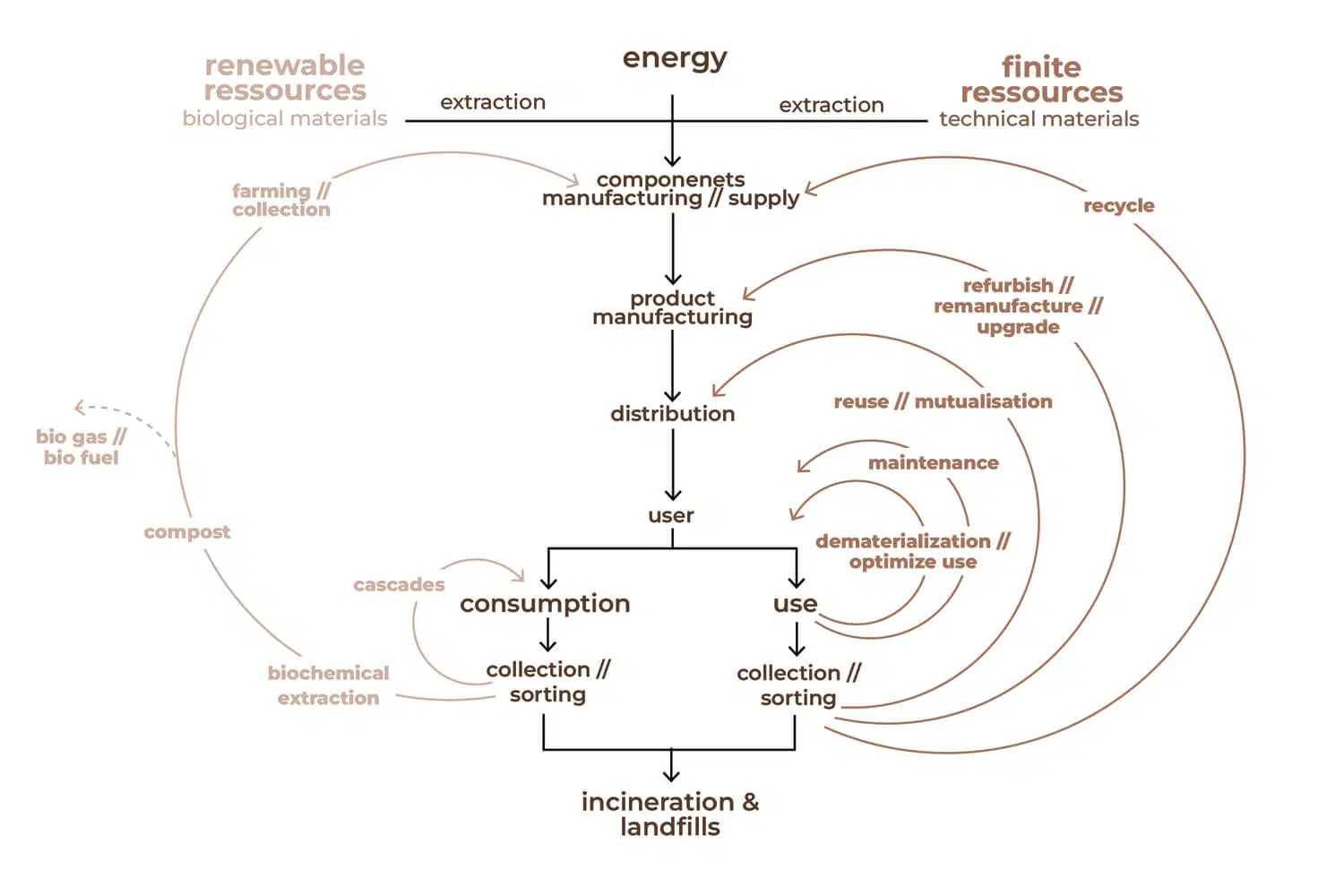 The emphasis is on decisions made early in the design phase that allow products to stay in use, be adapted, or be recovered instead of being discarded and ending up being burned or in landfills (brown lines). It highlights:
- Design for disassembly, so products can be taken apart efficiently for repair, adaptation, or material separation
- Modular product architectures, allowing upgrades or partial replacement rather than full product scrapping
- Repairability and user participation, with clear pathways for maintenance that extend product life
- Multifunctional and multigenerational use, reducing the need for additional products over time
- Cascading material use, where resources flow through successive applications rather than becoming immediate waste
Taken together, these ideas highlight sustainability as a question of value retention and adaptability, not just material choice or recycling rates. They make a compelling case for why sustainability must be designed in from the start (and these ideas closely align with cradle-to-cradle thinking, by the way).
Where the discussion becomes more difficult, and more interesting, is when these principles move beyond design intent and into real-world manufacturing. I’ll now share some thoughts on this…
Circular design starts with intent, but survives on execution
Concepts like design for disassembly or modularity are not new. Many product teams already discuss them early in development. The challenge is that intent alone rarely survives first contact with manufacturing.
A product designed to be disassembled only delivers sustainability benefits if:
- Fasteners remain accessible after cosmetic parts are added
- Components survive repeated disassembly and reassembly
- Factories follow the intended assembly sequence rather than shortcuts
- Cost-down exercises do not quietly replace screws with glue
In practice, we often see products that could be repairable in theory but are not repairable in reality because these downstream decisions were never controlled. That makes sense; it’s often cheaper and easier not to follow through.
This may be a design failure; it may also be a process failure.
Modularity and repairability can increase complexity and risk
Modular design and user-repairable products sound attractive, and they can be powerful. But they also introduce real engineering and quality challenges, which can be off-putting for manufacturers.
Every module interface is a potential failure point. Every repeated assembly cycle stresses plastics, threads, seals, and connectors. Products designed to be opened must be validated differently from sealed products, not just once, but repeatedly.
When repairability is introduced without updated validation strategies, tighter tolerances, and clearer assembly standards, the result is often higher field failure rates rather than improved sustainability.
This is a common disconnect we see: sustainability features are added, but the engineering and quality systems remain unchanged, resulting in a high return rate.
Sustainability is locked in early, but enforced later
One point the Punctuate Design article makes, and that we see very clearly in practice, is that sustainability outcomes are largely locked in during early design decisions.
Material selection, product architecture, part count, and fastening methods determine what is possible later. Once steel tooling is cut and suppliers are selected, your options quickly become limited.
However, early intent only becomes real outcomes if it is enforced later through:
- Supplier capability assessment and alignment
- Tooling and assembly process reviews
- Test criteria that go beyond basic function
- Documentation that explains why certain design choices must not be changed
Without this enforcement, designing for sustainability’s intentions can be quietly swept under the rug during production ramp-up.
If you’re interested in how these ideas play out on the buyer and supplier side, Sofeast has a useful overview of how procurement decisions shape real sustainability outcomes in their article on responsible and sustainable purchasing practices.
Factories tend to do just what they are measured on
Factories do not necessarily ignore sustainability, but they optimize for what they are measured on.
If lead time, yield, and unit cost are the only metrics that matter, sustainability features that might slow assembly, require additional care, or increase inspection time will likely be treated as problems to be removed at the DFM stage — unless specified as critical.
This is why sustainable product design cannot be separated from supplier alignment and quality & reliability management. Factories must understand not just how to build a product, but what must not be changed, and why.
When that understanding is missing, even well-designed products drift away from their original sustainability goals.
Sustainability is not the same as compliance
There is also an important distinction between sustainability and compliance.
Passing environmental regulations or material standards does not guarantee that a product is durable, repairable, or long-lived. A compliant product that fails prematurely still generates waste, often more waste than a non-certified product that lasts twice as long.
From a real-world perspective, product reliability is one of the strongest sustainability levers available, yet it is often discussed separately from sustainability initiatives.
For readers wanting more context on how regulators are now pushing sustainability into product requirements, Sofeast has a clear primer on the EU’s Ecodesign for Sustainable Products Regulation.
Final thought
The value of the Punctuate Design article is that it reminds us that sustainability is primarily in the realm of product design.
But in manufacturing, design intent is only the starting point.
Sustainable products emerge when design, engineering, suppliers, and quality systems are aligned, and when sustainability is treated as a performance requirement, not a slogan.
Good design makes sustainability possible.
Good execution is what makes it real.




Leave a Reply