
The circular economy in manufacturing is often treated as a single sustainability goal, but in practice, circular economy options vary widely by product category, materials, and early design and sourcing decisions. For example, what works for textiles may be technically unrealistic for electronics, and strategies that sound “green” can actually introduce cost, quality, and compliance risks.
For businesses manufacturing their products, the real challenge is not whether to pursue circularity, but which circular economy strategies are technically feasible, commercially viable, and aligned with product risk.
In this guide, we break down the circular economy hierarchy from best to worst, with practical examples for electronics, consumer goods, and textiles, and explain why early product design and DFM matter far more than end-of-life recycling claims.
The Circular Economy Hierarchy in Manufacturing (Explained)
Understanding the circular economy hierarchy is important for making realistic sustainability decisions. Higher-ranking strategies preserve more embedded energy, materials, and value, while lower-ranking options often recover little and can even increase risk.
Learn more about how the EU is demanding that products be designed with sustainability in mind: EU Ecodesign regulation
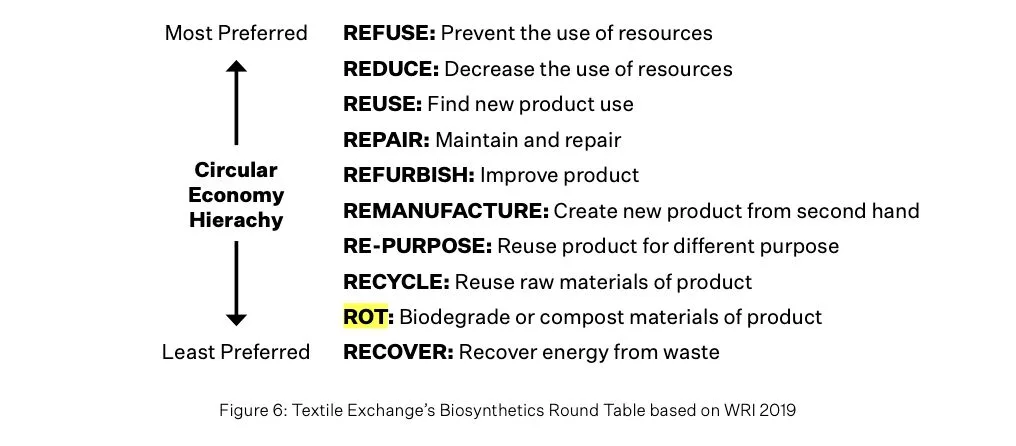
(Image source: Textile Exchange p38)
Summary of Circular Options and their Impacts
| Circular Option | Electronics | Consumer Goods | Textiles |
|---|---|---|---|
| Reduce | High impact | High impact | High impact |
| Repair | Medium–High | Medium | Medium |
| Recycle | Low–Medium | Medium | Low |
| Biodegrade | Not viable | Limited | Often misleading |
1.Refuse and Reduce: The Most Effective Circular Economy Strategies
Reducing Resource Use Through Product Design
Refuse and reduce sit at the top of the circular economy hierarchy because they eliminate waste before manufacturing even begins.
Examples by category:
- Electronics: minimizing component count, avoiding oversized batteries or using no batteries at all, and removing redundant features
- Consumer goods: reducing material thickness, simplifying assemblies, eliminating decorative-only parts
- Textiles: lowering fabric weight, avoiding unnecessary blends, minimizing trims and finishes
These strategies are locked in during early product design and DFM, interlinking sustainability and engineering decisions. Fewer materials usually mean lower cost, fewer opportunities for defects, and less manufacturing waste.
2. Reuse and Repair in Circular Manufacturing: Designing for Product Longevity
Extending Product Life Through Repairability and Durability
Reuse and repair focus on extending product lifespan by designing products in a way that enables maintenance, replacement, or refurbishment, and/or by making the product more durable in the first place.
Examples by category:
- Electronics: modular design, replaceable batteries, mechanical fasteners instead of glue
- Consumer goods: durable housings, replaceable wear parts, standardized components
- Textiles: repairable seams (with low risk of damaging the fabric), reinforced stress points, spare buttons or panels
Designing for repair, disassembly, and/or durability increases upfront engineering effort but often reduces warranty claims and early field failures.
3. Refurbishment and Remanufacturing: Practical but Category-Dependent
Where Refurbishment Makes Commercial Sense
Refurbishment and remanufacturing are established circular manufacturing strategies, particularly for electronics and durable products.
Examples:
- Electronics: refurbished devices such as smartphones, laptops, etc, and remanufactured industrial electronics
- Consumer goods: tools, appliances, mechanical assemblies
- Textiles: limited mostly to resale or reconditioning
Extending product life generally has a lower environmental impact than recycling, as it preserves embedded materials and energy. (Source: The Sustainability of Biosynthetics, 2022).
Also, refurbished is no longer niche: in a U.S. survey, about 1 in 4 respondents reported buying a refurbished smartphone, and in France, about 1 in 6 phones sold were refurbished, while surveys show intention to buy refurbished next is even higher. (Sources: IDC (US purchase rate) + GSMA (France share) + Vodafone (intention)).
4. Repurposing Products: Difficult to Scale in Manufacturing
Why Repurposing Is Rarely a Design-Led Strategy
Repurposing gives products a second life but is rarely scalable or controllable from a manufacturing perspective.
Examples:
- Electronics: component reuse in secondary, low-reliability applications
- Consumer goods: containers reused for storage or organization
- Textiles: garments repurposed into wipes, insulation, or accessories
Because repurposing depends heavily on downstream users, it is difficult to design into a controlled manufacturing model.
5. Recycling in Manufacturing: Necessary, but Often Overestimated
The Limits of Recycling as a Circular Economy Solution
Recycling recovers materials but often requires high energy input and results in downcycling. Therefore, it sits lower in the circular economy hierarchy because of its limitations.
Examples:
- Electronics: complex disassembly, low recovery rates for critical materials
- Consumer goods: plastics downcycled into lower-grade applications (with aluminum as a notable exception)
- Textiles: fiber blends that are difficult or impossible to separate; risk of using fabrics that include restricted chemicals (e.g. REACH). Textile Exchange stresses that recycling should be treated as a last-resort material recovery option, not a substitute for upstream circularity decisions (Textile Exchange, 2022)
Recycling should be treated as a fallback, not a primary circularity strategy.
6. Biodegradation and Energy Recovery: The Least Preferred Options
Why These Options End the Product Lifecycle
At the bottom of the hierarchy are biodegradation and energy recovery, which effectively end material value.
Examples:
- Electronics: largely irrelevant due to hazardous materials
- Consumer goods: limited to specific packaging use cases
- Textiles: biodegradable fibers often fail to degrade under real-world conditions. Even Textile Exchange, quoted earlier, cautions that biodegradability frequently does not deliver the expected environmental benefit outside controlled conditions
These options offer minimal circular value and frequently fail to deliver the expected environmental benefits.
Key Takeaways for Product Teams and Importers
Circularity is not about choosing the “greenest” label, it’s about making better-informed engineering and sourcing trade-offs that balance sustainability, quality & durability, cost, and risk.
- The most effective circularity options are decided at the earlier design and sourcing stages.
- Reducing material use and designing for repair and reuse consistently deliver higher environmental and commercial value than downstream recycling or biodegradability claims.
- Recycling should be treated as a fallback option, not a primary circular economy strategy, especially for electronics and complex assemblies.
- Poorly chosen “green” design choices often increase product risk, leading to higher defect rates, compliance issues, warranty claims, and total landed cost.
- Circularity must be evaluated alongside quality, durability, cost, and regulatory risk, not in isolation.
- The most effective circular strategies align engineering reality with commercial constraints, rather than relying on end-of-life solutions that recover little value.
FAQs
- What are the best circular economy options in manufacturing?
The most effective circular economy options in manufacturing are refusing unnecessary materials, reducing resource use, and designing products for repair and reuse, as these preserve the highest material and energy value. - Why is recycling considered a lower-priority circular economy strategy?
Recycling typically requires additional energy, recovers limited material value, and often results in lower-quality materials, making it less effective than upstream design-led circular strategies. - How does product design affect circularity?
Most circularity outcomes are determined during early product design and sourcing decisions, such as material selection, component architecture, and ease of disassembly. - Is biodegradability a good sustainability solution?
Biodegradability often fails to deliver real-world environmental benefits outside controlled conditions and is generally a last-resort option in the circular economy hierarchy. - Which industries benefit most from refurbishment and remanufacturing?
Electronics and durable consumer goods benefit most from refurbishment and remanufacturing due to higher retained value and established secondary markets.




Leave a Reply