
Why you need Reliability Engineering & Testing
If your product is not reliable or functional above all else, you will be overwhelmed by customer complaints, returns, or even product recalls. Therefore, any company developing a new electro-mechanical product that wants to confirm and/or improve on its latest design needs this reliability engineering and testing solution because each product, including its intended use, is somewhat specific and needs a customized plan.
(Remember, many defects come from manufacturing, and they are usually detected right after delivery; many defects also come from design, and they are typically detected 6-18 months after delivery.)
And any importer who buys existing products without being 100% sure that they have a history of performing safely also needs to go through this process for peace of mind.
(note: this comes in addition to compliance testing. Just following the applicable safety regulations of your country may NOT be sufficient to keep you out of trouble, depending on the product and its applications.)
Reliability Engineering & Testing can include various types of work. In many cases, it includes these:
- The evaluation and forecast of the way a product will behave once it is used “in the field” (or “in the end-users’ hands” for consumer goods), and
- The improvement of the product design in order to ensure the product is less likely to fail early.
What types of testing are done during product development & production?
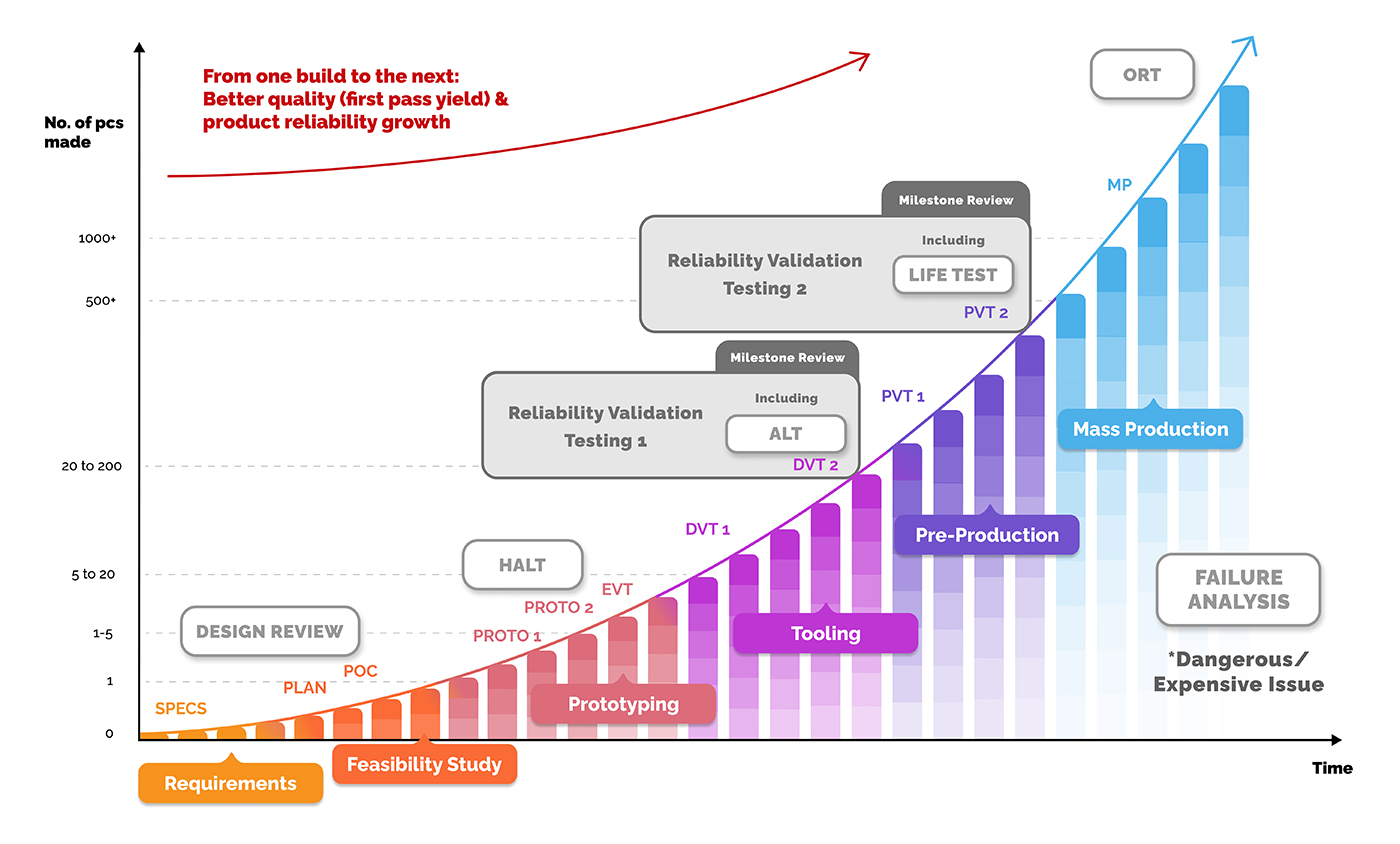
Reliability Engineering & Testing activities, such as HALT, Life Test, and ORT, take place throughout the new product introduction process using our in-house testing equipment, as you can see:

This makes particular sense if you are planning to sell an electrical, electronic, and/or mechanical product and if a failure after sale might have disastrous consequences. For example, if your product includes batteries, a charger, a heating system, or other risky components, make sure it is unlikely to hurt anybody.
Putting together a serious reliability test plan is not just a formality or a quick template job. Even for a relatively simple system, it typically takes several hours (often 2–4) because there is real engineering work and judgment involved at each step.
Here’s what goes into it:
- Checking what’s already been proven in your industry
We first research applicable industry standards for products similar to yours. This ensures the test plan is based on proven, relevant reliability methodologies, not guesswork. - Translating real-world use into test cases
We then define the right test cases based on how the product will actually be used and how it might fail. This step connects real-world use cases and potential failure modes to concrete tests. - Writing detailed, lab-ready procedures
For each test case, we write clear step-by-step procedures. Testing laboratories will not (and should not) perform tests without precise instructions covering the method, required equipment, measurements to be taken, and the pass/fail criteria. - Building a complete, shareable plan
Finally, we assemble everything into a structured test plan you can easily share with factories, engineering teams, and testing labs so everyone is aligned on what will be done and why.
What you’re really paying for is the engineering expertise and technical judgment needed to understand your product and tailor a plan that targets its real risks. A well-designed reliability test plan helps uncover the most critical issues early; once these are fixed, product durability in customers’ hands improves significantly.
No reliability program can guarantee zero failures in the field, but a proper, thoughtful test plan greatly reduces the likelihood of severe or costly problems later on.
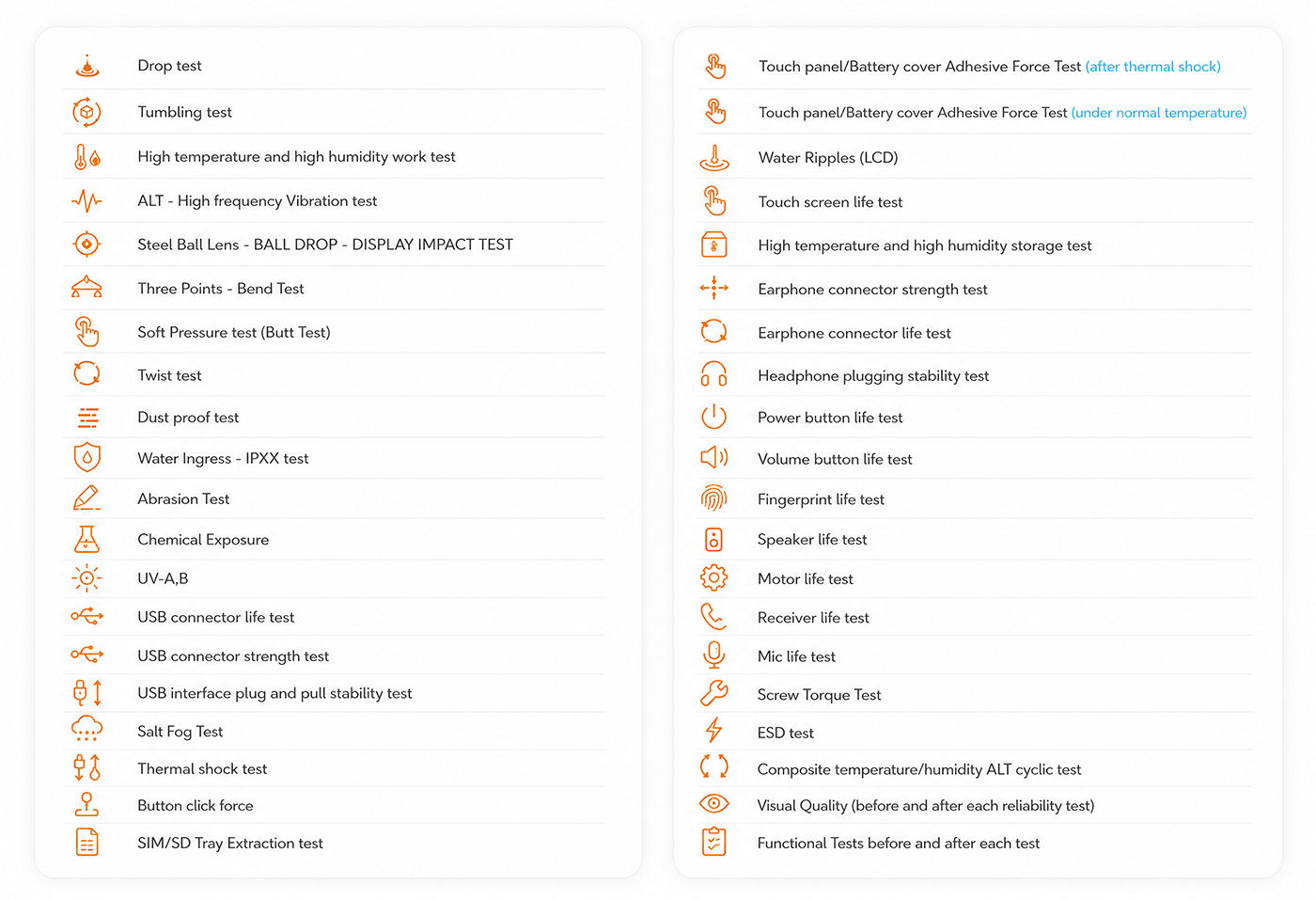
We provide a wide range of reliability tests (here’s our in-house testing equipment) to suit your specific requirements. Here’s a list of some popular tests we offer, although we’re not limited to just these:

- Is the product likely to keep working all through its intended life (or warranty duration), based on intended use?
- What are its failure modes? (This helps designers to improve on the design tremendously.)
- Is there a chance the product leads to safety issues or other catastrophic breakdowns?
- Is the packaging likely to protect the product during transportation and warehousing?
We provide you with a test report that is based on the scope of work you approved, with comments in case issues are found.
- Performing a DFM review will confirm how feasible your product design is. Our engineers examine your design files to confirm that the materials and processes required won’t cause unwanted problems when it’s time to manufacture your product.
- If you’re launching a new product our Compliance Testing Consulting solution will also be useful. Our team assesses your needs and will confirm which compliance testing is suitable and provide quotations from 2 trusted laboratories for it.
What does reliability engineering & testing cost?
We provide a tailored price for each client based on the scope of work.
Ready to get started with product reliability testing? Click the button below to talk about it with us and get a quote.

Andrew Amirnovin
NPD Head & Reliability Engineer
Our head of New Product Development, Andrew Amirnovin, is an electrical and electronics engineer and a reliability & quality expert who previously worked with electrical giants such as Nokia, AT&T, LG, GoPro, and Medtronic.
Andrew is an ASQ-Certified Reliability Engineer and he is our customers’ go-to resource when it comes to building reliability into the products we help develop.

Renaud Anjoran
CEO & Reliability Expert
Founder and CEO of the Sofeast group, Renaud is a recognised expert in quality, reliability, and supply chain issues and is an ASQ-Certified ‘Quality Engineer’, ‘Reliability Engineer’, and ‘Quality Manager’, and a certified ISO 9001, 13485, & 14001 Lead Auditor.
He often helps oversee reliability projects.