
Consultation then we quote for the first block of work (Starting from a minimum of US$1,000) SPEAK TO US
 
sofeast dfm review

A prototype can prove that your concept works, but it does not necessarily mean your design is ready for production.

Our engineers review your design files using a broader DfX lens to identify issues related not only to manufacturability but also to assembly, quality, reliability, testing, and cost.

You receive practical recommendations for your next design iteration, helping you reduce production risk before problems become expensive to fix.

This service may be suitable for:

  • Inventors and product developers with an advanced product design
  • Hardware startups preparing to industrialize a product
  • SMEs and larger companies developing, updating, or transferring a product
  • Engineering teams preparing for tooling or production
  • Teams approaching design freeze
  • Companies that want an independent engineering review before committing to production

The review is most valuable when the design is sufficiently advanced for detailed analysis but can still be changed without major downstream disruption.

We start by understanding your design intent, product objectives, requirements, and constraints.

Our engineers then review your design files to assess how easily and consistently the product can be manufactured, assembled, inspected, tested, and brought into production.

Depending on the product and the agreed scope, the review may cover:

  • Design for Manufacturing
  • Design for Assembly
  • Design for Quality
  • Design for Reliability
  • Design for Test
  • Design for Cost

The review may also identify implications for tooling, compliance, suppliers, inspection processes, and logistics.

The exact scope depends on your product, its maturity level, the files available, and your priorities.
Many teams discover too late that a product that looks good and functions well is still difficult to manufacture efficiently and reliably.

Design decisions that appear acceptable during prototyping can cause problems when the product moves toward tooling, assembly, testing, and production. These may include:

  • Parts that are difficult or inconsistent to manufacture
  • Unnecessarily tight tolerances
  • Complicated or error-prone assembly processes
  • Weak inspection or test coverage
  • Reliability risks that were not apparent during prototyping
  • Unnecessary material, tooling, labor, or processing costs
  • Compliance or supply chain issues that delay the launch

A DfX review helps you identify these risks while changes are still manageable and much less costly than they would be after design freeze, tooling, or production launch.

1. Understand your product and design intent

We ask questions to understand the product’s intended functions, user requirements, operating environment, target production volume, quality expectations, and other important constraints.

2. Review the available design files

Our engineers review the relevant mechanical, electrical, and electronic design information using a structured, checklist-based process.

The files reviewed may vary depending on the product and the stage of development.

3. Identify production-related risks

We assess the design across the agreed DfX areas and identify decisions that may create manufacturing, assembly, quality, reliability, testing, or cost problems.

4. Recommend improvements

We provide practical recommendations for the next design iteration, explaining where changes may reduce risk or make the product easier to manufacture and control.

This is a review and advisory service. Any follow-on design work, testing, sourcing, or NPI support is scoped separately.

The output of your DfX review may include:

  • A review of your product’s design intent, objectives, requirements, and constraints
  • An assessment of the ease of manufacturing custom parts
  • An assessment of the ease and consistency of product assembly
  • A structured, checklist-based engineering review
  • A list of identified risks and concerns
  • Recommended changes for the next design iteration
  • Comments on manufacturing, tooling, testing, inspection, sourcing, or cost implications where relevant

The precise deliverables will be confirmed when the scope of the review is agreed upon.

We do not believe manufacturability should be reviewed in isolation.

A design decision that looks acceptable from a narrow DfM viewpoint may still create:

  • Difficult or time-consuming assembly
  • Low process robustness
  • Inconsistent product quality
  • Weak field reliability
  • Poor inspection or test coverage
  • Compliance difficulties
  • Supply chain constraints
  • Unnecessary production costs

DfM therefore remains an important part of the review, but it is not the entire review.

The broader DfX approach allows our engineers to consider how different design decisions may affect the product throughout manufacturing, testing, supply, and use.

How much does a DFM review cost?

Simple projects typically start from US$1,000.

The final quote depends on:

  • Product complexity
  • The number and maturity of the design files
  • The number of mechanical, electrical, or electronic systems involved
  • The DfX areas included in the review
  • The depth of analysis required

We will confirm the scope, deliverables, and price before starting the review.

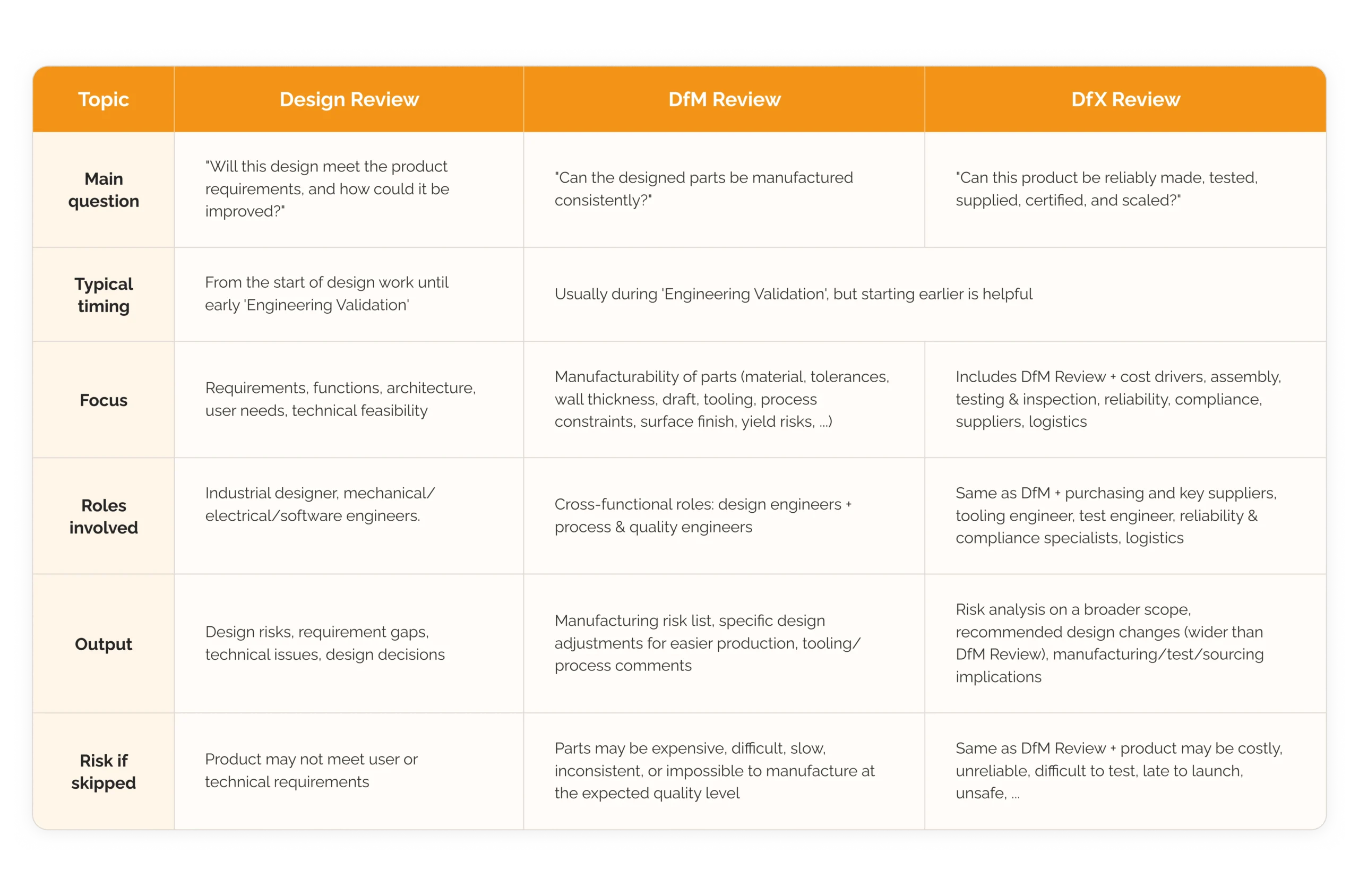
DR vs. DFM vs. DFX

Topic Design Review DfM Review DfX Review
Main question “Will this design meet the product requirements, and how could it be improved?” “Can the designed parts be manufactured consistently?” “Can this product be reliably made, tested, supplied, certified, and scaled?”
Typical timing From the start of design work until early ‘Engineering Validation’ Usually during ‘Engineering Validation’, but starting earlier is helpful
Focus Requirements, functions, architecture, user needs, technical feasibility Manufacturability of parts (material, tolerances, wall thickness, draft, tooling, process constraints, surface finish, yield risks, …) Includes DfM Review + cost drivers, assembly, testing & inspection, reliability, compliance, suppliers, logistics
Roles involved Industrial designer, mechanical/electrical/software engineers. Cross-functional roles: design engineers + process & quality engineers Same as DfM + purchasing and key suppliers, tooling engineer, test engineer, reliability & compliance specialists, logistics
Output Design risks, requirement gaps, technical issues, design decisions Manufacturing risk list, specific design adjustments for easier production, tooling/process comments Risk analysis on a broader scope, recommended design changes (wider than DfM Review), manufacturing/test/sourcing implications
Risk if skipped Product may not meet user or technical requirements Parts may be expensive, difficult, slow, inconsistent, or impossible to manufacture at the expected quality level Same as DfM Review + product may be costly, unreliable, difficult to test, late to launch, unsafe, …

Request a quote for your DfX review, and let’s determine the most appropriate next step for your product.

1First Step
2Second Step
  • Get A Quote For Your DFM Review

    Thanks for your interest in choosing Sofeast to help support your new product development and perform a Design For Manufacturing review for your peace of mind.

    Please fill out the form to let us know who you are, your contact information, and some details about your project so that we can get back to you.

FAQs about Sofeast DFM reviews

DfX means reviewing a product design across multiple production-relevant dimensions.

Rather than looking only at whether individual parts can be manufactured, the review may also consider assembly, quality, reliability, testability, cost, compliance, suppliers, and other production implications.

Manufacturability alone does not determine whether a product will be easy to launch and produce successfully.

A product may contain manufacturable parts but still be difficult to assemble, inspect, test, source, certify, or produce reliably. DfX more accurately reflects the broader engineering scope of the review.

Ideally, the review should take place before design freeze, while meaningful changes can still be made without expensive disruption.

Starting earlier can also help prevent unsuitable design decisions from becoming embedded in the product.

No. A working prototype demonstrates that the product concept can function, but it does not necessarily prove that it can be manufactured consistently, assembled efficiently, tested adequately, or produced at the required quality and cost.

Your team uses the findings and recommendations to improve the next design iteration.

Where additional support is required, follow-on design engineering, reliability testing, compliance support, sourcing, or NPI services can be scoped separately.

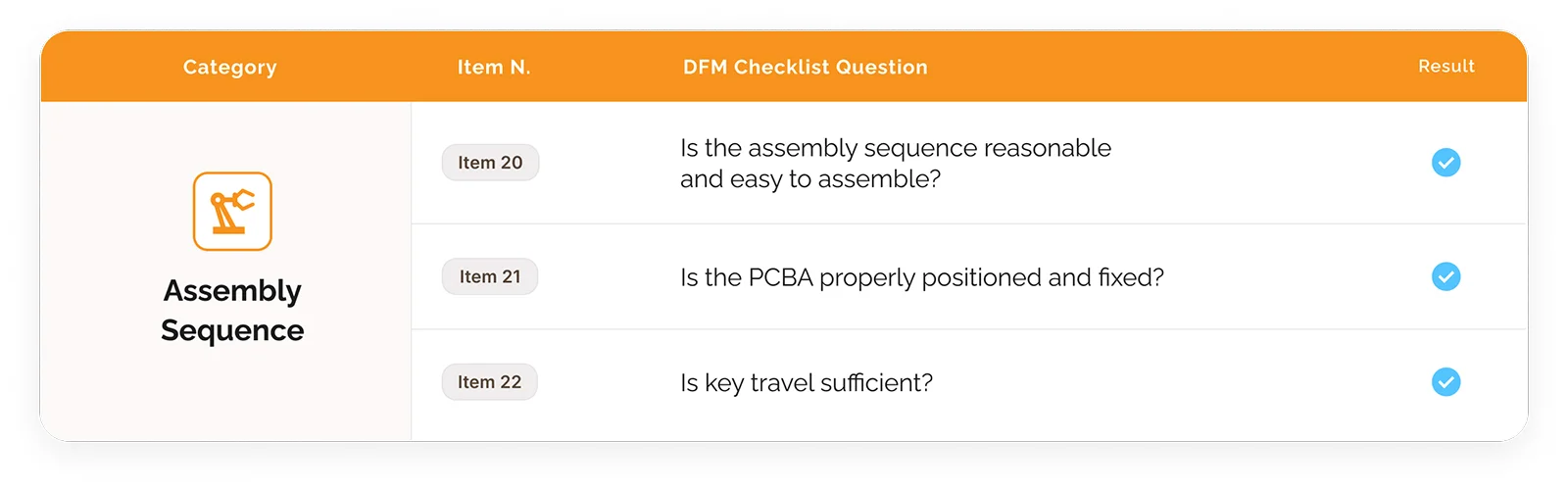
Our own checklist formulated by our in-house product design engineers includes 70 points for mechanical design and 20 points for electrical/electronic design, as a starting point.

Here’s an excerpt of our DFM review checklist so you can see some of its detail and the checkpoints our engineers cover:

sofeast DFM checklist excerpt

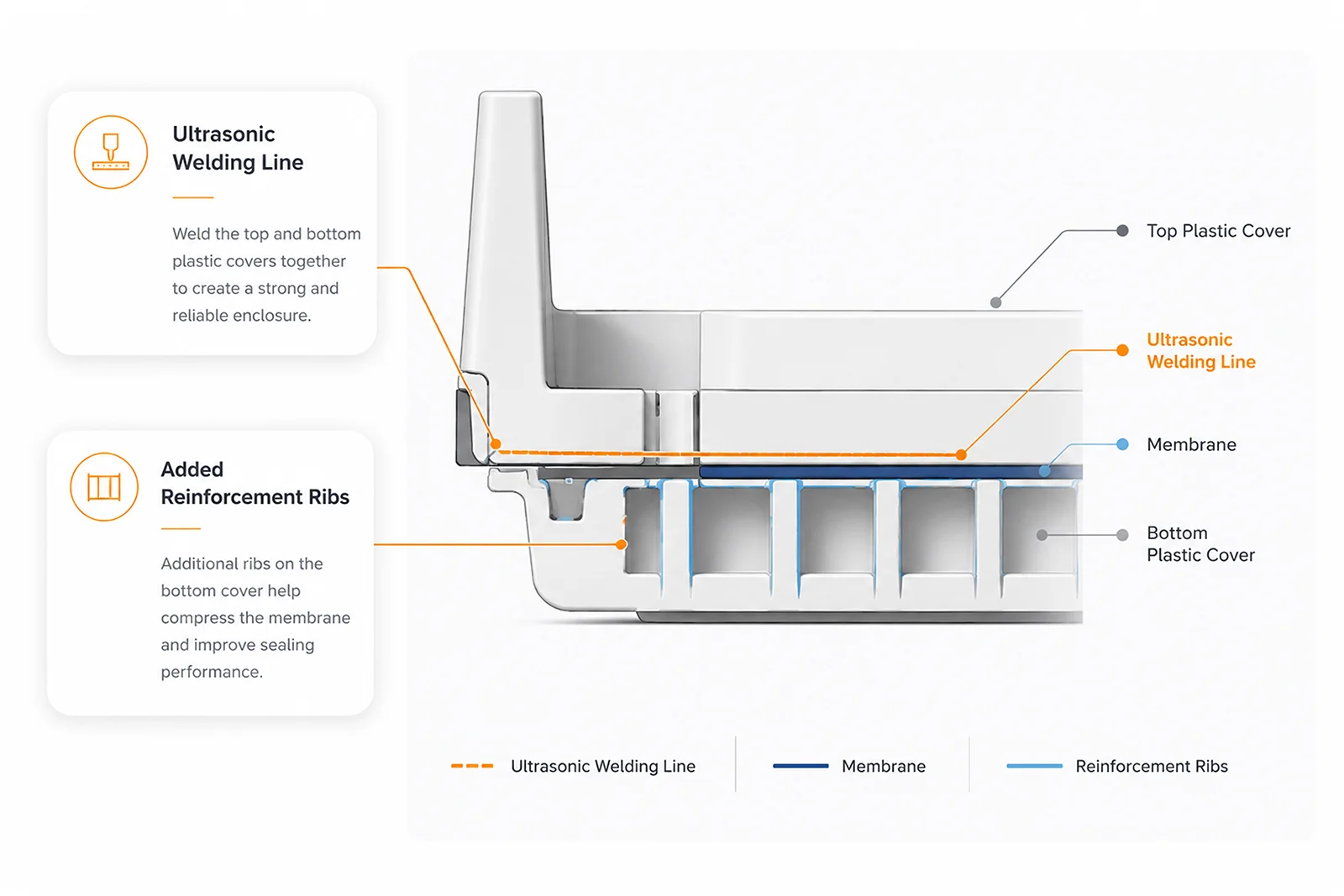
Following the DFM review, our engineers will suggest some design improvements that will make your product more manufacturable. Here’s an example improvement we’ve made before about improving ultrasonic welding on a product:

dfm review example improvement

Comments are closed.