



Sofeast’s team continues to monitor the cost evolution of key raw materials in China, helping importers and manufacturers stay informed.
This latest update from the market analysts we work with reflects changes in RMB costs and percentages through October 27, 2026.
Click the charts to expand them.
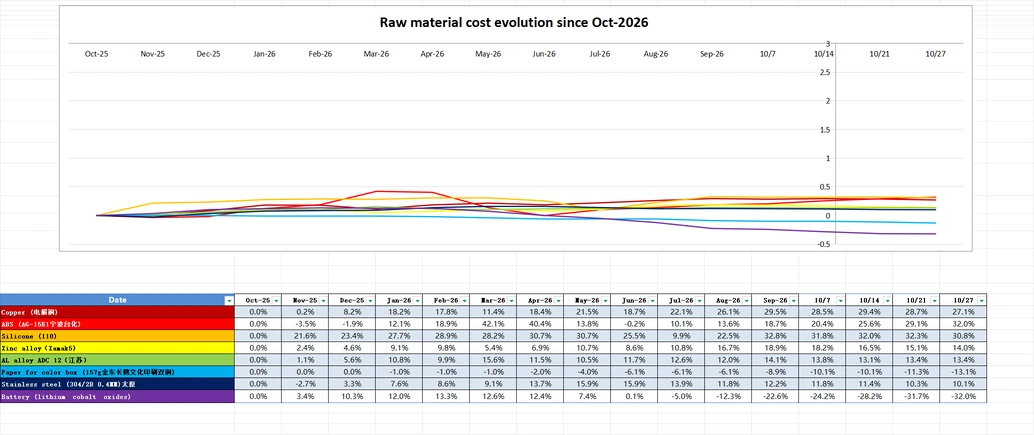
Monthly China Raw Material Cost Changes – October 2026
October saw prices decline across most of the raw materials we track, although ABS plastic was a notable exception.
ABS recorded a substantial 11.21% monthly increase, making it the strongest performer among the eight materials in this update.
Meanwhile, battery materials continued their downward trend, falling another 12.23%. Packaging paper and zinc alloy also recorded notable decreases, while copper, silicone, aluminum alloy, and stainless steel experienced smaller declines.
Despite these recent reductions, several materials remain considerably more expensive than they were a year ago.

Copper – Monthly Change: -1.84%
Copper prices declined moderately during October, including a further 1.26% decrease in the latest week.
Drivers
Copper prices softened as market conditions became less supportive of further increases. Orders have stabilized, helping to reduce some of the upward pressure seen in previous months.
However, copper remains approximately 27.1% more expensive than it was in October 2025.
Outlook (next month)
Production activity among refined copper rod manufacturers is expected to recover, which could help support demand. Copper prices may stabilize during November, although further movements will depend on the balance between supply and purchasing activity.
ABS (AG-15E1) – Monthly Change: +11.21%
ABS recorded the largest monthly increase in this update, rising by 11.21% compared with September.
Prices also increased by another 2.25% during the latest week, continuing the upward trend seen since the summer.
Drivers
Higher production costs have provided support for ABS prices, particularly at the lower end of the market.
However, trading conditions remain mixed, with buyers generally purchasing according to their immediate needs rather than building substantial inventories.
Outlook (next month)
Production cost pressures could continue supporting ABS prices during November. Moderate fluctuations are likely, although further substantial increases will depend on whether downstream demand improves.
Silicone (110) – Monthly Change: -1.51%
Silicone prices declined slightly during October, reversing part of the strong increases recorded in August and September.
The latest weekly decrease was 1.10%.
Drivers
Silicone manufacturers are generally managing their inventories, but new orders and advance purchases have slowed.
Some producers are becoming more willing to accept orders as demand weakens, placing modest downward pressure on prices.
Outlook (next month)
The price of DMC, a key upstream silicone material, is expected to remain stable or slightly weak.
This could reduce production cost pressures and keep silicone prices relatively stable or slightly lower during November.
Zinc Alloy (Zamak 5) – Monthly Change: -4.12%
Zinc alloy prices declined by 4.12% during October, including a further 0.98% reduction during the latest week.
Drivers
Electrolytic zinc prices fluctuated throughout the period but moved lower overall.
Although shortages of zinc concentrate continue to provide some support, visible inventories have increased, reducing concerns about supply constraints.
This has limited the potential for further price increases.
Outlook (next month)
Supply constraints and a potentially more supportive economic environment could encourage a modest recovery in zinc prices during November.
However, higher inventories may limit the strength of any rebound.
Aluminum Alloy (ADC 12, Jiangsu) – Monthly Change: -0.59%
Aluminum alloy prices remained relatively stable during October, declining by just 0.59%.
There was no change in the tracked price during the latest week.
Drivers
Aluminum prices recovered somewhat during the latest trading period as market sentiment improved.
However, the recovery was followed by relatively narrow price fluctuations, leaving the overall monthly movement small.
Outlook (next month)
Improving market sentiment and support from industrial demand could encourage a modest recovery during November.
Prices may initially rebound before settling into a relatively narrow trading range.
Paper for Color Boxes (157 g, Double-Coated) – Monthly Change: -4.66%
Paper used for printed color boxes continued to become cheaper during October, falling by 4.66%.
Prices declined by another 2.05% during the latest week.
Drivers
Demand for coated printing paper remains weak, with buyers continuing to purchase cautiously.
Some paper manufacturers have shut down production lines, while further maintenance is expected at facilities in Shandong and Jiangsu.
Despite these supply reductions, demand has not improved significantly, and distributors remain focused on selling existing inventory.
Outlook (next month)
Reduced production could help limit further price declines, but weak demand is likely to continue weighing on the market.
Paper prices may remain under pressure during November unless purchasing activity improves.
Stainless Steel (304/2B 0.4 mm, Taiyuan) – Monthly Change: -1.87%
Stainless steel prices declined moderately during October, falling by 1.87%.
The latest weekly movement was a smaller decrease of 0.24%.
Drivers
The market has experienced some short-term price recoveries, but overall demand remains relatively weak.
Purchasing activity following China’s October holiday period did not recover as strongly as some market participants had expected.
This reduced confidence and contributed to the overall monthly decline.
Outlook (next month)
Reduced production of some upstream raw materials could provide additional cost support for stainless steel.
Prices may stabilize or recover modestly during November, although a stronger increase would probably require better downstream demand.
Battery Materials (Lithium Cobalt Oxides) – Monthly Change: -12.23%
Battery materials recorded the largest monthly decline among the materials tracked, falling by 12.23% during October.
Prices decreased by another 0.54% during the latest week, continuing the downward trend recorded over recent months.
Drivers
Prices for ternary battery precursor materials continued to decline.
Lithium carbonate prices also weakened, contributing to lower prices for lithium iron phosphate (LFP) materials.
Some downstream energy storage companies have reduced production activity, although overall demand for LFP materials remains relatively strong.
Outlook (next month)
Battery material prices may remain under downward pressure during November if upstream prices continue to weaken.
However, relatively strong production activity among LFP manufacturers could provide some stability to parts of the market.
What stands out this month?
October’s figures highlight an increasingly mixed picture for manufacturers sourcing materials in China.
ABS was the clear exception to the general downward movement, increasing by more than 11% during the month. It is now approximately 32% above its October 2025 level.
Copper and silicone are also considerably more expensive than they were a year ago, despite their modest October declines.
Battery materials present the opposite picture. After another substantial monthly reduction, the tracked price is now approximately 32% lower than in October 2025.
Packaging paper has also continued to become cheaper, while zinc alloy, aluminum alloy, and stainless steel experienced more moderate movements.
For importers, the important lesson is that raw material prices do not all move together.
A supplier manufacturing a product with substantial ABS content may genuinely be facing higher costs, while another making products that rely heavily on battery materials or packaging paper may be seeing some cost relief.
When reviewing supplier quotations or requests for price increases, it is worth checking which materials actually contribute to your product’s bill of materials (BOM) and whether recent market movements justify the proposed changes.
How to combat rising costs?
Explore cost-reducing tips in this post: Rising Raw Material Prices: What Strategy To Follow? (6 Approaches).
What to do if your Chinese supplier suddenly tells you that material costs have risen: How To Cooperate With Your Chinese Supplier, Part 16: Bad News from China, Raw Material Prices Just Increased!
If your supplier just isn’t working out, maybe sourcing a new supplier will help you find one who can offer you better prices and more. If so, there’s no need to fear switching from your current supplier to a new one if you’re prepared: How To Switch To A Newer, Better Chinese Manufacturer? [eBook].
We hope this is helpful. Our mission at Sofeast is to provide importers with transparency in their supply chain and to give them greater control. And this information is crucial for gaining visibility into your manufacturer’s costing.
By the way, you can always contact us if you have any questions about whether a manufacturer’s quote is reasonable or not.