



A customer recently came to us with a problem involving plastic injection molds made by another supplier in China.
The molds had already been fabricated, but the parts coming out of them were not acceptable. There were visible cosmetic defects, concerns about dimensional accuracy, and questions about how long the molds would last.
Unfortunately, by the time we were asked to look into the situation, there was relatively little that could be done to correct some of these problems.
This is a situation we see quite often. A company wants to get some plastic parts made, finds a supplier who offers an attractive price, and assumes the supplier will make the right technical decisions.
But what if the supplier is making a mold for a different purpose than the customer has in mind?
That seems to be a big part of what went wrong here.
What went wrong with these plastic injection molds?
I asked our mold workshop manager (based at our contract manufacturing subsidiary, Agilian) to review the situation and explain the main problems. He identified three serious weaknesses.
1. The supplier selected low-grade mold steel
The first problem was the material used to make the molds.
The supplier had selected relatively inexpensive, low-grade steel, presumably to keep the tooling cost down.
There is nothing inherently wrong with using cheaper mold materials. For example, a company that only needs a small quantity of prototypes might reasonably choose a softer, less durable tool. However, the choice of steel must match the intended application.
In this case, the selected steel created two significant problems:
- Poor surface finishing: The steel could not be polished to the standard required to produce the desired appearance and texture on the molded parts.
- Limited mold life: The tooling was unlikely to withstand the number of molding cycles expected from a production-grade mold.
If you only want to make a few hundred parts to check their fit and basic functionality, these compromises might be acceptable.
But if you expect the same mold to produce attractive, consistent parts over many production runs, they can become serious limitations.
In my opinion, one way to avoid this would have been for the supplier and customer to agree on the mold’s intended lifespan, steel grade, and surface finish requirements before any steel was cut (tooling fabrication started).
2. The mold design did not account for cosmetic requirements
The second problem was more serious because it was built into the mold’s design.
Our engineer found that the gating system, particularly the location of the gates through which molten plastic enters the mold cavity, had not been properly planned.
Why does this matter?
When molten plastic enters a mold, it flows around the cavity until the part is filled. Depending on the part’s geometry and where the plastic enters, different flow fronts can meet and create a visible line on the finished surface.
These are called weld lines (a representative, and pretty scary, example is below).
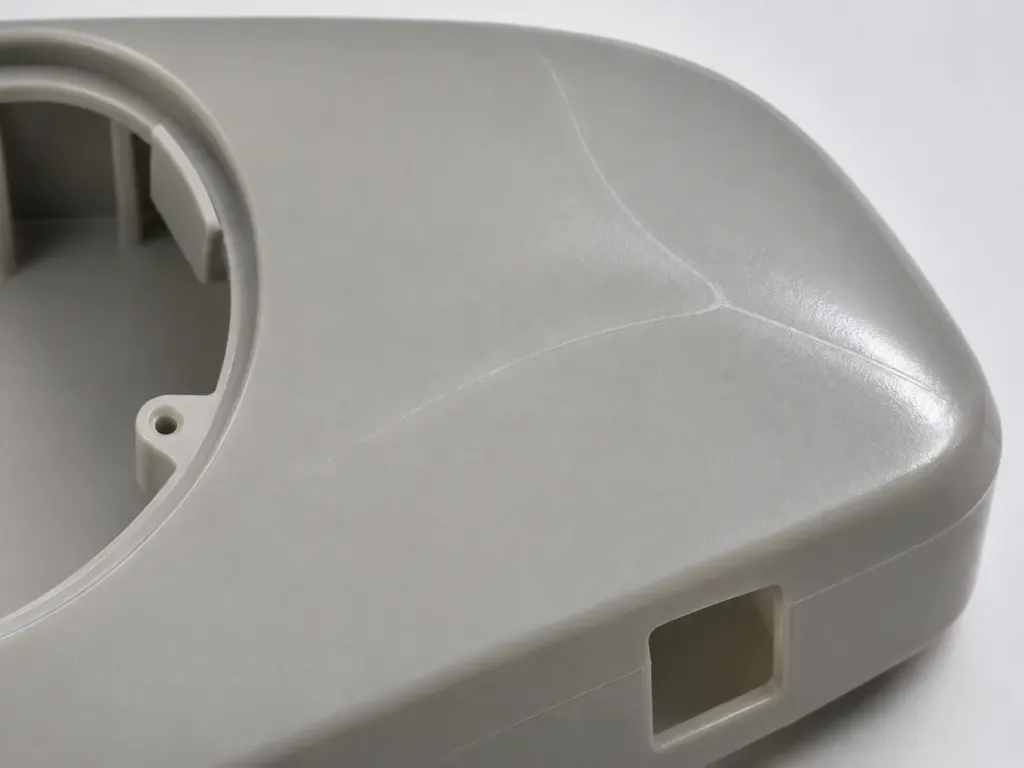
Weld lines are common in injection molding, and they are not always a problem. Sometimes they can be hidden in areas that customers will never notice. Their severity also depends on the material and molding conditions.
However, on a consumer product with an exposed, highly visible plastic surface, a prominent weld line may be completely unacceptable.
That was one of the main problems in this case.
The customer was also seeing gloss variation, with two visibly different shades or surface appearances on what should have been a uniform, flat surface.
Our engineer linked both problems to the poorly planned gate locations.
The mold design had simply not taken the customer’s cosmetic expectations sufficiently into account.
There were also concerns about part warpage, where the molded plastic changes shape as it cools.
A mold needs to be designed with these potential issues in mind before steel is cut. Once the gates and other critical features have been machined, changing them can be difficult, expensive, or even impractical.
3. The cooling system had not been properly designed
The third weakness was the mold’s cooling system.
Cooling is one of the most important aspects of plastic injection molding. A mold is essentially a cooling device! And yet it is sometimes treated as a secondary consideration when a toolmaker is trying to minimize costs or deliver a mold quickly.
In this case, our engineer found that the cooling channel layout had not been adequately considered.
This created two potential problems.
- The mold was not optimized for an efficient molding cycle. If the plastic takes longer than necessary to cool sufficiently for ejection, the factory will produce fewer parts per hour, increasing the unit manufacturing cost.
- Poorly controlled or uneven cooling can contribute to warpage and dimensional variation.
A properly designed cooling system helps control how the part solidifies and reduces the risk of deformation. It should also allow for reasonable process adjustments during molding trials.
Here, the cooling layout offered limited flexibility to manage those issues.
So, even if the supplier adjusted molding temperatures, pressures, or cycle times, there would be limits to what those adjustments could achieve.
Can these molds be repaired or reworked?
This is probably the most frustrating aspect of the whole situation.
When I asked our mold shop manager what the customer could do now, his assessment was not encouraging.
The molds had already been completed, and there was very limited room for improvement.
Some issues might be reduced through process adjustments or tooling modifications, but the main cosmetic defects could not be fundamentally corrected with the existing mold design.
This leaves the customer with some difficult choices:
- They could accept the defects, provided the parts remain suitable for their intended use and meet their quality requirements.
- They could explore modifying the existing molds, but that would add cost and might not produce satisfactory results.
- Or they might have to make new molds from scratch, this time with the correct materials and a properly engineered design.
That last option could mean paying for tooling twice and losing valuable time before production can begin, which is precisely why a low initial tooling price can be misleading. (At least the initial “prototype mold” can be used for some engineering validation, but not for production.)
The real cost of tooling is not simply the price quoted by the mold maker. It also includes the cost of modifications, delays, rejected parts, and potentially replacing the molds altogether.
Was the plastic injection molding supplier entirely at fault here?
Not necessarily.
This is an important point, and one that some foreign buyers sometimes overlook.
From the supplier’s perspective, the customer appeared to want some tooling to make prototypes.
If that was the brief, a relatively inexpensive mold, produced quickly using softer materials and limited engineering work, might have seemed perfectly reasonable to them. They’d be thinking: “Why spend additional time and money optimizing a mold for a long production life, short cycle times, and an excellent cosmetic finish if the customer only needs some prototype parts?”
The problem is that in this case the customer’s expectations were different.
They needed parts with certain aesthetic and dimensional characteristics, and potentially tooling that would remain useful beyond the initial prototyping stage, but those expectations had not been clearly communicated or translated into agreed technical requirements.
In this case, it likely would have helped if the supplier had asked more questions. A competent toolmaker ought to clarify the intended use of a mold before recommending its construction.
However, remember that you also have a responsibility to explain what you need.
We often see this mismatch when companies are developing new products in China. It all comes down to the wrong assumptions on both sides.
What should you specify before ordering plastic injection molds?
If you are an importer, hardware startup, or established brand developing a product with custom plastic parts, you should not simply send a 3D CAD file to a supplier and ask for a tooling quotation.
At a minimum, I’d suggest the following points need to be agreed upon.
- What is the mold actually intended for? Is it a temporary prototype mold, a bridge tool for an initial production run, or a production mold expected to manufacture hundreds of thousands of parts? These are different requirements, and they may justify very different tooling solutions.
- How many parts should the mold produce? Define the expected mold life, ideally in molding cycles or shots, and consider the expected production quantities. Do not assume that a supplier quoting for a mold is automatically quoting for long-term production tooling.
- What are the appearance requirements? Which surfaces will be visible to customers? What levels of gloss, texture, color consistency, and surface finish are required? Will some parts be white or transparent?
- What dimensional tolerances must the parts meet? Identify critical dimensions, and ideally also assembly interfaces, flatness requirements and any areas particularly sensitive to warpage. The supplier needs to know which characteristics are essential to the product’s function and safety.
- Will the mold design be planned and reviewed before fabrication? A proper Design for Manufacturing (DFM) review is a must before steel is ordered and cut. The tooling structure, gate locations, parting lines, ejection system, and other important topics need to be clarified. A risk analysis (what defects might come up?) is needed. And, for certain complex parts, mold flow analysis can help identify risks while a design change is still relatively inexpensive.
Spending a little more on engineering can prevent an expensive mistake
There is a tendency among some buyers to compare mold quotations primarily on price.
One supplier quotes US$8,000, another quotes US$12,000, and the natural reaction is to ask why the second supplier is so expensive.
But are they actually quoting for the same thing?
Perhaps the more expensive quotation includes better steel, a more sophisticated cooling system, a more suitable gating arrangement, and additional engineering work before fabrication. Or perhaps it doesn’t. A higher price is not proof of a better design, either.
The point is that you need to compare the technical specifications and engineering approach, not just the tooling price.
This is particularly important for companies developing consumer products where appearance, assembly accuracy, and consistent quality matter.
Our customer’s experience illustrates the cost of skipping that work.
Don’t wait until the first molded parts are defective
If you are planning to manufacture custom plastic parts in China, it is worth having an experienced engineer review the tooling proposal before you authorize fabrication.
At Sofeast, our teams can help with DFM reviews, plastic injection mold tooling management, and first article inspections to identify potential problems before they become expensive surprises.
And if your molds have already been made and the parts are not meeting expectations, we can help assess the technical issues and determine what corrective actions may be realistic.
The best time to discover a mold design problem is before the steel has been cut, not after you’ve paid for the finished tool.
Contact Sofeast to discuss your plastic injection molding or tooling project.
