



Table of Content
Select any of the chapter to jump to a particular section of the guide
Chapter 1
Do You Need a Sourcing Agent?
If you are starting to buy from China, your first decision will be: should I manage this by myself?
If your team can’t dedicate one hour a day (per supplier) to follow what happens in China, you might need help from a sourcing agency that can handle these tasks:
- Identifying new suppliers that can make your products at the right price and quality levels;
- Helping develop new products/styles with these suppliers;
- Ongoing management of supplier relationships (communications, quality control, shipment follow-up, crises if any)
You actually have 4 options:
1. Purchase direct
This is what 80% of importers try to do. They want to control the whole process, and avoid paying commissions to any middleman or agent.
If you are organized enough to manage suppliers (as you will learn in the next emails of this series), and if you can satisfy the minimum order quantities (MOQs) of suppliers, this is probably the best option for you.
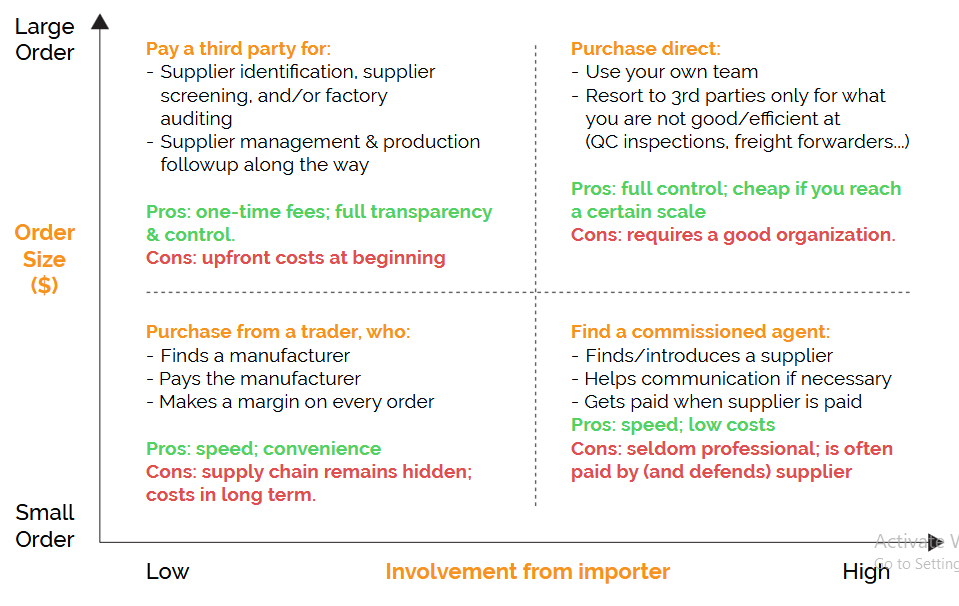
2. Use a commissioned agent
Thousands of individuals in China are trying to make a living by providing this service. If they are from the right industry, you can use their network and save a lot of time. They can also act as your ‘in-country’ representative.
Unfortunately, over 95% of them get a hidden commission from the factory. This is “normal business” in China. As a result, when things go wrong, they often tend to defend the factory!
Dan Harris has a similar view of most agents:
I often describe China sourcing agents with the following: “Ninety percent are crooks or incompetents and most are both of these things. But ten percent are worth more than their weight in gold.”
3. Purchase from a trading company
This is a good option if you cannot satisfy the MOQs. A trading company can place production in a smaller workshop that accepts small orders. Aside from this particular situation, I advise against working with a middleman.
I wrote about some downsides of working with a trading company before.
4. Use a service company
Some agents provide a service and charge a fee. Everything is transparent (supplier names, process followed…). It will be an investment for your company before production starts, but it is a good option if you forecast large orders down the road.
There are very few such agents. They tend to work like a procurement office and to be well organized.
Qualifying an agent
Here are a few questions to ask sourcing agents before you engage one:
- How will they get paid, and by whom?
- Will you be able to visit the factories before/during production?
- Can they provide referrals or testimonials from satisfied customers who are using their services and who buy the same type of product as you? Make sure to contact two of them and get confirmations.
- Do they do quality inspections by themselves? Or do they resort to a specialized third- party? Will you get a report every time?
- Will you get an update every week on the production status?
- Can they share their management system with you? You need to make sure they have processes in place. The vast majority of agents don’t follow any established procedures.
- What guarantee do they offer in case a supplier scams you? If shipments are behind schedule? And if you receive junk product in your warehouse?
- Are they located in the area where your products will be sourced? (Do a quick search on globalsources.com and you will have an idea about the main area for your product category.)
- If you keep re-ordering the same products from the same sources, will you pay less for his services after the first order?

Chapter 2
How to Identify Potential Suppliers?
Now I am assuming that you have decided to source in China by yourself.
One Key point I want to communicate is this: you need to follow a process. You CANNOT browse a website, send a few emails, respond, and see where it takes you.
If you want a written checklist that you can adapt and follow, you will find an example here. It deals with sourcing, development, production, and transportation.
But let’s look at the sourcing process first in more detail. It includes 2 steps:
- Identifying potential suppliers;
- Screening these suppliers and verifying the last candidate(s).
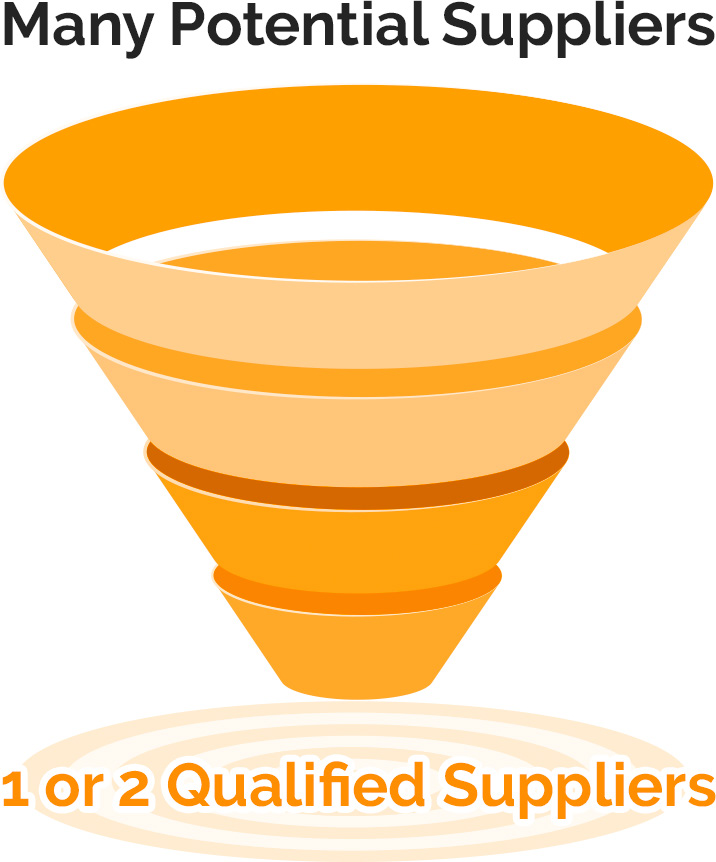
For now, let’s focus on the first step, which itself includes 3 sub-steps:
Sub-step 1. Drawing your ideal supplier profile
Ask yourself a few questions:
- Do you need a supplier with strong engineering capabilities (to develop new products)?
- Do you need them to have a wide range of designs that you can choose from?
- Do you want them to focus on low cost? Or on high quality?
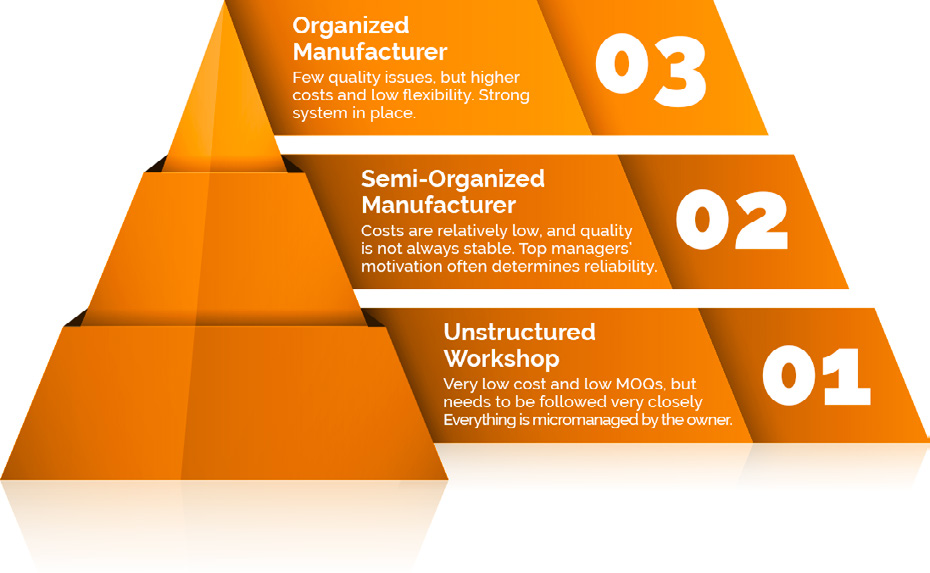
- How big should they be? This is a very important criterion for the reasons discussed below. You will encounter factories belonging to these 3 levels, and their performances and prices will be vastly different:
Here is my general advice on the topic of the supplier’s size:
- If your orders are very small, you might need to work with a trading company that will place your orders in a level 1 factory and (hopefully) follow production closely.
- If your orders are large enough to work directly with a manufacturer, but not big enough to be interesting to big factories, go for level 2 (250-800 workers, roughly).
- If your orders are considered large and you find the big companies actively fighting for your business, then level 3 is good for you.
Sub-step 2. Go to online B2B directories and/or trade shows
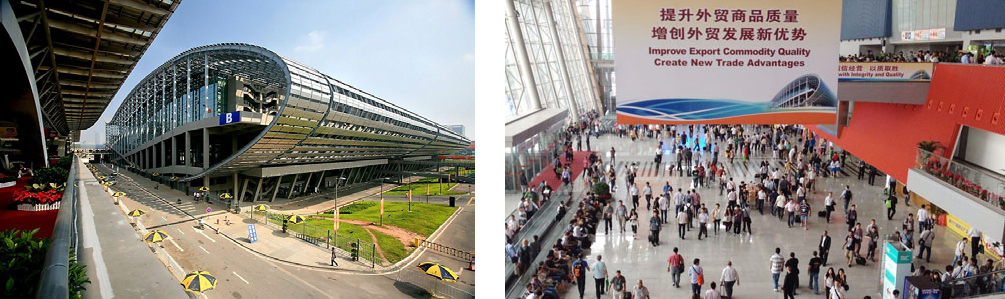
If you can get the opportunity to go to a trade show (Canton Fair, China Sourcing Fairs, and so on) that deals with your product category, go there! Ask a few open questions, the objective here is to eliminate any supplier that doesn’t fit with your ideal profile.
If you can’t physically get to a trade show, you will need to use B2B directories. Beware! They function like the yellow pages (suppliers who pay more, get their products featured more prominently). There is not as much effort to avoid listing bad apples as you might think.
Make sure you look at the information inside the profiles, to target only those suppliers that correspond to your ideal profile. For example, by keeping only suppliers with a minimum capital of 1 million RMB or above (this information is available on global Sources), you are eliminating 99% of trading companies from your search results.
Sub-step 3. Motivate potential suppliers to respond to you
Most suppliers get too many inquiries and need to choose which ones they respond to. Here are a few tips to get their attention.
- The first message should be short, less than 8 lines if possible (including the product description), and with a VERY CLEAR call to action (“get back to me if you want more information about our needs”).
- If you have a product specification sheet, share it with them and get their feedback. You should expect them to ask questions about manufacturing, like material specification or, if they don’t accept your tolerances, etc., if they say “it’s fine” this is not always a good sign.
- And then… Follow up fast in responding to their questions, and finalize your screening process within 8 days. After that, your inquiry, in their eyes, will have gone cold.
- If possible, call them (most of them have a Skype account and they all have a WeChat account — these 2 applications allow you to make calls for free if both parties are connected). Show that you are human and that you are investing your time to get to know them.
A big mistake to watch out for
Some potential suppliers will offer a price that is much lower than average. How is this possible?
- Some suppliers want to start developing a product with you, and they will know tactics to increase the price along the way (usually after the deposit for the first order has been wired).
- Some other suppliers simply don’t know what the costs are. They have never made this product, even though you found it in their showroom. They will wonder where and how to manufacture it after you have sent them a PO. This is also a bad sign.
So, what to do?

You will likely see several very similar quotes from different suppliers: that’s the “market price”. Eliminate all the “outliers” that gave prices 20% higher or lower than the average. (If you are consciously looking to buy above the market price to get above-average quality, keep the highest quotes).
End of the identification phase
Ideally, you have compiled this information in an Excel spread sheet, with data and comments. (Contact me if you don’t have time for that, and I will put you in touch with someone who can help.)
The next step is to screen most potential suppliers out, and to verify the last one or two in more depth. This will be covered in the next chapter.
Chapter 3
How to Verify a Manufacturer
If you have followed the advice in chapter 2, you have found a few interesting suppliers. The next step is to confirm that they told you the truth and that they are reliable.
Even if you place one-shot orders, you should spend a little time to check if a potential supplier is legitimate. You don’t want to fall victim to a scam, do you?
There are three main ways you can verify a manufacturer:
1. Background checks
You want to avoid scammers who will run away with your deposit, but also manufacturers who told you lies about their size, trading companies that pretend to own a factory, and so on.
You can gather some information for free on search engines and on B2B directories, as I detailed in these 2 articles:
If possible, ask potential suppliers for customer references. Ideally, you could talk to one or two such customers on the phone. Ask them how long they have been working with that manufacturer, and ask them to identify the supplier’s strengths and weaknesses.
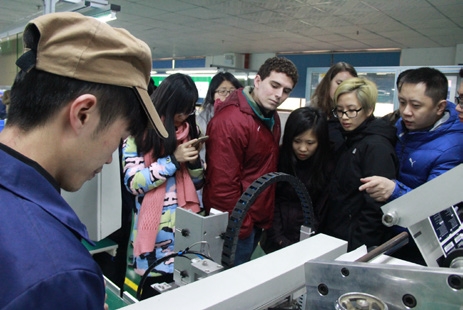
This is a particularly subtle part of the verification process, for two reasons:
- Many of these references will be fake. Or maybe they did produce for Disney, but 3 years ago and through another factory that subcontracted the job out to them.
- Many legitimate manufacturers will refuse to communicate the contact information of any customer, for fear that you work for one of their competitors.
Another approach that works well is to call the supplier salespeople themselves! We have found that they lie much less on the phone than in emails. And they tend to simply hang up the phone — or become aggressive — when they are asked questions they are not comfortable answering.
2. Factory visits
At the entrance of every trade show in China and Hong Kong, the organizer should have a notice warning visitors of the following:
- Do NOT believe the facts and photos shown on brochures.
- Do NOT give importance to ISO 9000 certifications.
- Do NOT trust what salespeople tell you without checking it.
For an order of 2,000 USD, I can understand why you wouldn’t spend time visiting the factory. But, for large orders, failing to verify the manufacturer’s claims is asking for trouble.
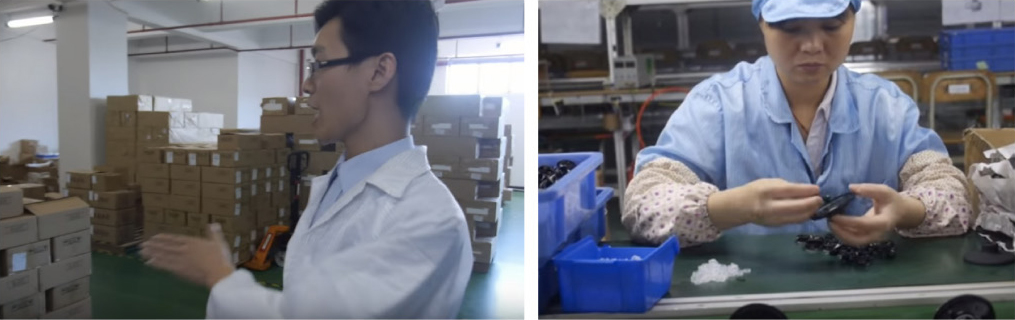
If you visit the factory by yourself, your hosts will try to impress you. Instead, use your eyes and try to grasp the situation and understand the overall environment. An example of what to look out for during a factory visit can be found in this article.
If you can’t visit the factory by yourself, a solution is to pay a third-party quality assurance firm for a quality audit. Companies like ours have auditors in the main manufacturing areas and do this type of mission routinely for importers.
Also, if a QA agency is focused on serving SMEs, they will offer an entry-level audit service around 300 USD. (If you are looking for factory audit services, we’ll be happy to serve your needs).
A word of caution about factory audits
Third-party audits look scientific (a score is generally given to each candidate). But do not follow the factory’s score blindly.
What looks like the “best” factory to auditors might not be suitable for your company. It might well be a big factory. But you might need a smaller factory. Remember your supplier ideal profile.
3. Face-to-face meetings
Let’s say you took the time to visit the factory. Should you rush through the visit in 2 hours, and try to visit 2-3 factories in a day?
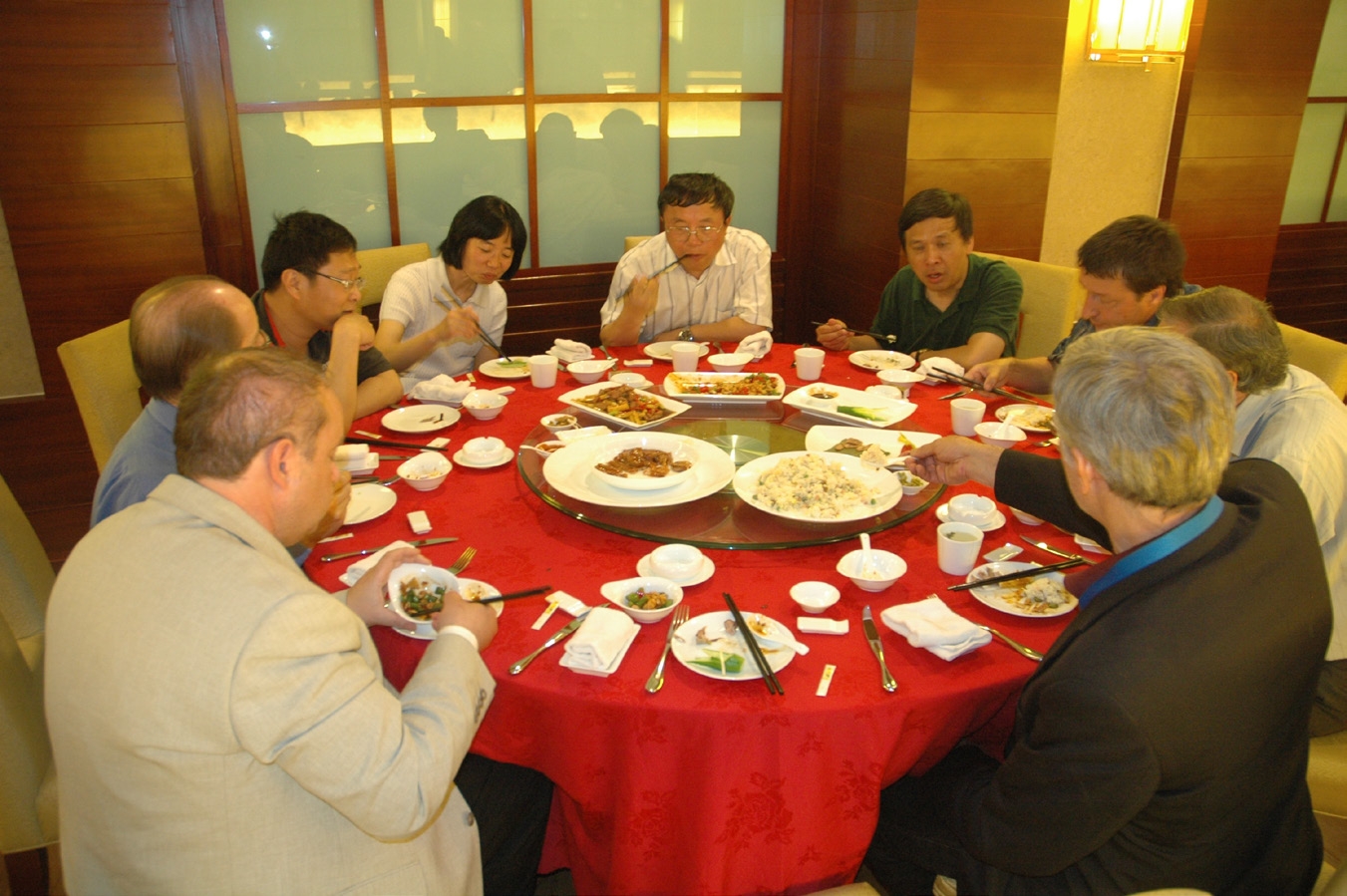
If you have found a factory that seems to be a good fit for you, you need to spend time there. You need to get to know them, and vice versa. Business is often done around a dinner table.
Let’s say you have a problem down the road, and you only know the salesperson who handles your account. You will wish you had had dinner with a manager so that you would have a second person to call!
So the first reason for socializing is the need to know a few more people from the factory. And the second reason is to gather information.
In an informal setting such as a dinner, try to ask a few questions to gauge the owner’s long term commitment to his company. If he mentions he is investing heavily in real estate, this is not a good sign.
You can see other examples of questions to ask in this article.
End of the verification phase
At the end of this process, if all runs smoothly, you will have one best candidate—to use for a trial order— and a few others to keep as backups.
Chapter 4
Second Choices vs. “Never Again”
By now I’ll assume that you have verified a few manufacturers.
One of them will be your first choice, and hopefully you will have a couple of “backups”. What’s the best way to handle them?
And what about the unfortunate situation where your “first choice” disappoints you?
1. Cultivate your “second choices”
With a bit of luck, you have found and verified a supplier that seems quite promising. If you want to reduce your risks of long delays, I strongly encourage you to keep communications open with a few more suppliers.
I even believe you should spend the time and the money to verify at least one more supplier, and to start working on pre-production samples with that supplier, even though they are not your first choice.
Why? Isn’t it a huge waste of energy from your side?
Maybe or maybe not. Depending on the industry, your order volumes, and your quality standard, the probability that your “first choice” lets you down can be as high as 90%.
It can happen for a variety of reasons:
- Maybe they have misquoted your product, and they increase the price by 35% after you issue the purchase order. Or, worse, they subcontract production to a small workshop that delivers terrible quality.
- Maybe they are very busy and don’t value your business much. They keep “bumping” your order behind higher-priority jobs.
- Maybe the salesperson leaves, and you have no other good contact there.
- Maybe they just can’t (or won’t make the effort to) reach your quality standard.
In any case, starting development with a backup manufacturer is a good idea, especially if you need them to make a unique or highly customized product. If you need to start development from scratch with a second supplier, it will probably take you as long as it took you the first time!

2. Those “never again” suppliers
 As I wrote above, some suppliers will prove to be untrustworthy. The worst scenario, which happens every day, is that they ship bad products to you and that you only notice this upon delivery in your warehouse – or, even worse, in your customer’s warehouse!
At that point, there is basically nothing you can do. Chances are, you have already paid the supplier in full, and taking action against the supplier is usually a dead end.
The manufacturer will only offer you a discount on future purchases, as compensation. But the last thing you want is to take risks with them again.
So, what should you do? It depends on your situation.
# The case of the first and, to date, only order
 Should you drop that supplier as soon as possible because they will (very) probably do it again? In this case, you will be happy to have a backup factory ready to “hit the ground running”.
But should you say “never again”, and burn bridges?
Not necessarily, for two reasons.
- A good production manager can be the difference between satisfactory shipments and late deliveries of substandard products. Maybe a lapse in quality is only temporary. Do not draw definitive conclusions.
- You should care about your image. Do not try to give them a hard lesson, because other manufacturers in the same area might hear about you and refuse your business when you contact them.
# The case of the complex relationship
Dropping a supplier suddenly is close to impossible once you have a regular flow of business with them. At any point in time, they have your deposits for several orders, and you count on them to deliver products that you need!
You need to be aware that this type of relationship can be very fruitful, but risks are pretty high too. As Jack Perkowski wrote:
“I was always struck by the way in which a dispute in one area with a partner, customer or colleague affects all aspects of the relationship in China. In the United States, we’re used to “compartmentalizing,” not letting a disagreement in one area affect the overall relationship. In China it’s different. You either have a good relationship or you don’t.”
Make sure that one accident does not throw the whole relationship off balance. I have seen this happen many times in China.
3. Protecting yourself from bad surprises
An ounce of prevention is worth a pound of cure, isn’t it?
Here are two simple pieces of advice.
First, make sure you check quality before shipment. Quality assurance agencies can help you with this. We’ll explore this topic in more depth in the next few emails.
Second, if you keep re-ordering the same products, you will need a safety stock, to avoid depending too much on your current supplier. How much exactly? It depends on the time it would take you to launch production in another factory.
(If you have no backup solution and if it takes 6 months to bring a new manufacturer up to speed, you will need a lot of stock… or maybe a good manufacturer in your own country. Depending on your product category and on your margins, this might be a good backup solution.)
Chapter 5
Negotiation: The Terms you Need to Discuss
Chinese suppliers are good at detecting which purchaser is inexperienced.
If that’s the case, and if you are dealing with dishonest suppliers, they could think that they will be able to take advantage of you.
Therefore, it is important that you come across as someone who is fully prepared. You need to know what to ask, and how to respond when a supplier is being unreasonable.
Let’s have a look at the main terms you will need to discuss with potential suppliers. I advise you to discuss most of these terms in your very first discussion/meeting with each potential supplier.
1. Total lead time (and shipment date)
From the very beginning, you need to ask them two things:
- What months are you most busy? And when are you less busy?
- Once a perfect sample is approved, and you get the green light for production, how
many days do you need before you can ship the goods?
ADVICE NOTICE:
You should always keep these two pieces of advice in mind when discussing lead times:
- Whatever they promise you, add 3-4 weeks to your internal planning if they are a new supplier and 2 weeks should be fine if they are already a regular supplier.
- When you discuss timing, always remind them that quality needs to be maintained to the approved standard. If you ask them to rush production, you are giving them an excuse for poor quality!
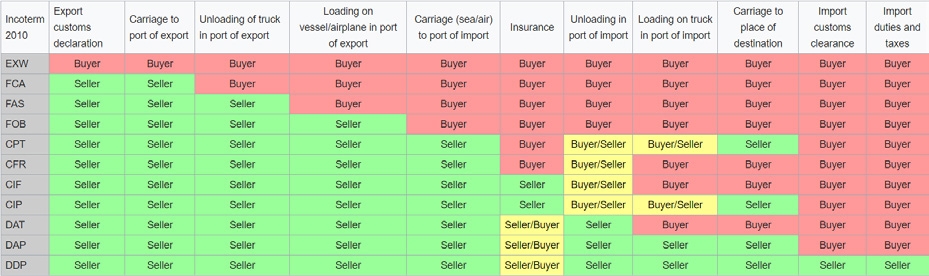
2. Incoterms
Click the table for more information
Along with their quotation, they should write something like “FOB Shenzhen” (or FOB another port). This means they pay the costs until the port of Shenzhen; you are then responsible for the shipment and delivery of goods to your final destination. FOB is by far the most common incoterm.
The good news is you are in control of the freight if you buy FOB, but you will need to find a freight forwarder — You can find out more about your 4 options in this article.
If the supplier offers to take care of the international freight, you should only accept it if the incoterm is DDP [your warehouse] or at a minimum of DDU [your warehouse]. It means they will take care of all the freight until your warehouse, door to door. NOTE: in DDU terms, import duties are unpaid, so you’ll need to work with a customs and excise broker.
Important note: do NOT accept CIF terms. In most cases, the price will be interesting but there is a catch… You will probably have to pay extremely high “local” fees.
When it comes to airfreight, specific incoterms apply. Your freight forwarder should be able to explain the nuances to you.
3. Intellectual property rights (if your product is unique)
Importers are often afraid of a Chinese company reverse-engineering and copying their products. But most cases of IP infringement involve the original supplier/manufacturer!
It should be no surprise, since they are the ones that went through the hard work of product development and getting the product into manufacture, they also have a sense of their buyer’s business model.
If you do not want your supplier to turn into your competitor, you should take a few precautions.
First, be aware of common legal strategies. You should register your trademark in China before production starts. And you should have your supplier sign a NNN agreement.
Let’s break the NNN down a bit:
- Non-disclosure agreement — most people think about this one. But the way it is written (in particular the jurisdiction that is competent in case of a breach) often makes it unenforceable.
- Non-use — since disclosure may be very difficult to prove, you want to make it clear that your confidential information will not be used outside of the intended project.
- Non-circumvention — you might not be able to prove that the receiving party disclosed the information or that they used it (it might be done in another facility, under a distant cousin’s name). But you also want to make sure they don’t try to sell your product to your own customer(s).
Second, use non-legal strategies. If you are ready to pay a little more to reduce IP risks, you should structure your supply chain yourself and place a firewall between its major elements:
- Find and qualify the components suppliers (that’s not a must);
- Distribute the processing and pre-assembly across several factories;
- Give the final step (assembly & packing) to a manufacturer that does not know the other factories involved, or that is specialized in acting as a “black box”. There are a few of them in China.
4. Access to, and transparency about, the manufacturing site
Even if you have confirmed that you work directly with a manufacturer, your order might be subcontracted to a small workshop—either because they run out of capacity, or because they want to widen their profit margin. When this happens, you run higher chances of a quality disaster.
So, what can you do to prevent it?
- Make it very clear to your supplier that production is to take place in the approved factory only, unless they get your written authorization to do otherwise for a particular order. Get a written commitment about this and place this term on your purchase orders.
- Have the supplier confirm that your representatives (be they your staff or a third party) can go in the factory and check your product at any time during production.
- Observe production if you can be on site, especially for the first run. You can also send in an inspector who will report on the location of production.
- Try to avoid your supplier’s peak season as well as the period around Chinese New Year.
5. Quality standard & product specifications, and certifications
In Chinese suppliers’ minds, quality is tightly linked to prices. If you ask for a low price, it isimplied that you will be less strict on quality.
Therefore, one of the key elements while negotiating is: you can discuss prices, but you need to make it extra clear that your quality standard is not negotiable. Better still, you should define your quality standards precisely.
You also need to make sure the product you are buying is compliant to the regulations of the countries where you intend to sell it. Tell the supplier about those countries. If you buy an off- the-shelf product, do they already have the right certifications? Can you see them? If not, who will pay for them?
6. Payment terms
Accepting a slightly higher price in exchange for more favorable payment terms can be great business.
If you purchase products in a very competitive industry, and if you know that many suppliers will fight to get your business, you can try to negotiate the following terms: 30% before production / 50% just after shipment / 20% after delivery in your warehouse.
Similarly, if you plan to use letters of credit, you need to mention it the very first time you exchange with a potential supplier. If they refuse this payment mode, or if the amount of your orders is too low to justify a letter of credit, it is best to know about it right away.
he advantage of a letter of credit is that you don’t get “hooked” by a 30% down payment (which is never ever sent back by a supplier to a customer).
7. Other common terms
Some other common terms that are often included in OEM agreements are:
- Who pay for the first inspection and the first laboratory test, and who pays the following ones in case of a failure
- Penalties for late shipment, chargebacks for mistakes, etc.
- Control over price increases
- Compensation if the supplier cannot deliver
- Right to refuse orders
A lawyer can tell you more about all this. But I hope I presented an overall picture that will be useful to some importers.

Chapter 6
Keep Some Leverage with Suppliers
Up until now, I have explained how to find a good supplier and what terms to negotiate from the get-go.
But this is not enough. Buyers who are new to China often make a mistake: they trust their suppliers too much.
China is a dog-eat-dog environment. You can’t trust a company simply because you have checked and qualified them. You need to structure your deals in such a way that you keep some power over your supplier.
I know three good ways of doing this
1. Payment by bank wire: release payments after milestones are reached
Bank wire (or “T/T”, which stands for “telegraphic transfer”), is the main payment method in international trade.
It is usually done in two steps:
- A 30% down payment, before components are ordered. Chinese suppliers like to call it a “deposit”, but make no mistake: they never return it once they receive it.
- The balance of 70%, to be paid after production is completed.
You should try to pay it after shipment, but many suppliers are reluctant to accept this – it means they get paid later than they would like, and they think this gives you the opportunity to “play games” (such as asking for a discount) after they have shipped the goods. In case you cannot negotiate final payment after shipment, make sure it takes place after product has been inspected and confirmed everything meets your specifications.

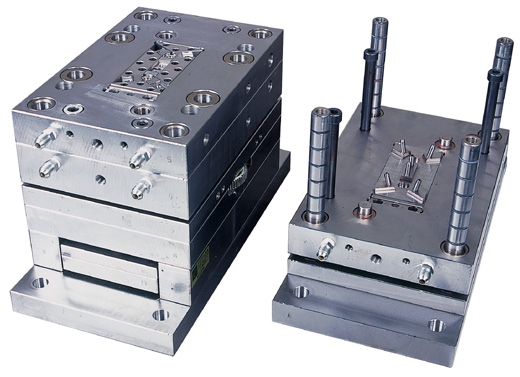
Special case: if an investment in tooling or molds is necessary
You might have to pay for molds before you get perfect samples. It makes sense. But, if the value is high, you might want to talk to a lawyer (see part 3 of this article).
If you negotiate that the supplier invests in molds by himself, he might ask you to pay 30% (for example) before he purchases the mold, then 30% before he starts production, and then the rest after production is done.
There is one option open to negotiate, that of amortization. This is normally a negotiating point where the mold tool capital cost is relatively high and the buyer negotiates with the supplier to spread the cost of the mold tool over, either a production period of time or a quantity of production items. An example of this is shown below:

The principle is that you should keep some leverage in your hands as long as possible. In practical terms, this means you owe some money to your supplier until shipment. This way, they will listen to your requests.
4 things you should NEVER do
- Never pre-pay 100% of the order before production starts. This is just dumb. I have seen buyers make this mistake and deeply regret it. Try it and you will understand why leverage is important!
- Never wire the down payment before having a high certainty that the factory knows exactly what you want. Many buyers issue a PO, then receive a perfect sample, and then send the down payment.
- Never wire money to a personal account.
- Never wire money to an account name that is different from your supplier name, without asking for a written explanation.
What you should try to negotiate for over time
As you become a regular customer, and if you feel the supplier is making a decent margin on your orders, you should ask for this payment structure: 30% down – 50% after shipment – 20% after delivery in your warehouse.
This is still relatively rare, but is slowly becoming more common.

2. Payment by letter of credit: safer for the buyer, but not always an option
Payments by letter of credit (L/C) are more complex than T/T. But they offer some benefits to the buyer.
How a L/C protects the buyer
- No advance payment is necessary (since the buyer’s bank guarantees payment to the seller’s bank, at condition that certain documents be presented);
- One of these documents should be a “certificate of quality control by [your nominated inspection firm]”. If the QC inspection didn’t happen, or was not acceptable to the buyer, the supplier needs the buyer to “waive the discrepancies” before payment is released.
- There are virtually always discrepancies. It means that, in the end, the buyer calls the shots. He can decide to waive discrepancies a little late, to extend payment terms. He is in a position to negotiate a discount if the supplier has cut corners somewhere.

Downsides of L/Cs
- They are expensive. Banks charge much higher fees for L/Cs than for T/Ts. It means they are not a realistic solution for orders below 30,000 USD.
- Many suppliers do not accept L/Cs. Maybe they are short on cash (and they need advance payments), or maybe they had bad experiences in the past. But sometimes, reassuring a supplier is enough to have them accept an L/C.
A few tips to reassure suppliers
- Many buyers pay by L/C for their first order with a new supplier, and then switch to T/T. If
that’s the case, make sure to mention it. - Use an international and famous bank to open your L/Cs.
- Better yet, show a draft of your L/C to the supplier before you open it formally. If they don’t agree on a term that is of minor importance to you, just let it go.
3. Sign an enforceable contract, for extra leverage
Most importers are NOT aware of these two facts:
- Your purchase order is not considered a contract!
- A contract that calls for litigation in your country is certain useless with a Chinese supplier, unless their company has assets in your country.
If you want a contract (also called “OEM agreement”) that you can enforce in a Chinese court of law or in an arbitration body, it should be drafted by a lawyer who is familiar with China business. (I usually recommend Dan Harris and Steve Dickinson, from Harris Bricken).

Most of the terms are fairly standard, but they should be customized to your situation:
- The written description of the product will be attached in appendix;
- Subcontracting can be forbidden;
- Payment terms can be formalized;
- Ownership of special tooling or molds can be clarified;
- IP non-disclosure can be requested.
The major benefit of having a contract is the leverage it gives you in front of your supplier. Naturally you don’t want to sue them, but you can threaten them to do so!
Drafting a Chinese contract is not cheap, but it is usually a one-time fee. Once you have the template, you can re-use it for other orders if the supplier accepts the same terms. It should be structured so that only the exhibits (product specs, purchase order…) need to be changed from order to order.
Chapter 7
Pre-Production: Describing What You Want
I have stated several times that you need to describe your product in detail.
I know this is obvious, but most buyers don’t do this well… and often regret it later.
There are two ways of formalizing your requirements:
- A written specification sheet, which contains all your expectations regarding the product and its packaging.
- Pre-production samples, which are supposed to represent what cannot easily be described in written form: the look & feel, the quality of the finishing, etc.
1. The written specification sheet
Writing a spec sheet before production starts serves two purposes:
a) Communicating your requirements, on your terms.
Even if you purchase standard items (with no customization), you should not rely on the supplier’s catalogue information. Some important information might be missing; the tolerances might be too loose, and so on.
Keep in mind that, for every specification that is not defined, you put your trust in the supplier to make a good decision.
But who will make these decisions? Purchasing officers and production technicians. In other words, people whose main objective it is to save money. For example, they will buy the cheapest cartons if you don’t specify the type of packaging you want.
Maybe you have no idea of what you really require. The easiest way is often to ask the supplier to show you what they do for other customers. If you want something different, ask the supplier to propose something else.
 b) Providing a basis for quality control.
Let’s say you purchase pens. When you receive the shipment, you notice that the pens run out of ink after writing for a day. You complain to the manufacturer, who tells you “of course, if you write for 24 hours nonstop, it is possible to run out of ink”. You reply “no, I mean after writing for 1 hour”. This type of discussion can last for a long time.
Is this a silly example? No. It is representative of the situation of many buyers who have not taken the pain to write their requirements down in a way that forms the basis of a quality control checklist.
To get back to the pens, an example of product specification could be: the pens should “provide for at least 2 km of writing on standard paper sheets” and “the empty space inside the cartridge should be between 0.5cm and 1.5cm”, this would be just part of the specification.
Note: Do not count on the supplier’s salesperson to take care of these details
Chinese factories often hire a few English-speaking young graduates to communicate with foreign customers. When you send your requirements, these salespeople will take care of the translation. But they are seldom good interpreters, because many of them have zero technical knowledge.
To avoid misunderstandings, here are a few tips:
- Use as many photos and drawings as possible, rather than text.
- If you have the resources for it, translate the specifications yourself.
- Even better, go in the factory and collect feedback/questions from technicians and managers. Don’t go through the sales rep’s filter. Ask a manager to stamp and sign on the document.
(Note: Quality assurance agencies can generally help with translation and feedback collection. We do this from time to time, and it improves communication immensely.)

Defining potential defects
How to define your quality standard? Or, put another way, what should be considered a major defect?
Unfortunately, pre-production samples are not sufficient since they don’t show any defects. So the definition of potential defects needs to be in the spec sheet.
It is virtually impossible to list 100% of possible defects. However, it is worth spending a little time defining the 20% of defects that come back 80% of the time.
Once you have a list of defects, you should decide on their severity, based on these three categories:
- Critical defects might harm a user, or do not respect the importing country’s regulations. Tolerance is generally 0.
- Major defects are usually not accepted by end consumers/users, so they would not buy the product. The corresponding AQL limit is generally 1.5% or 2.5%.
- Minor defects are the slight issues that usually don’t prevent the sale of the product. The corresponding AQL limit is generally 4.0%.
Using a template for the spec sheet
If you don’t know where to start, you are welcome to use the free template you will find here.

2. Pre-production samples (or “golden samples”)
Descriptions and photos only go so far. You should request a perfect pre-production sample (often called “golden sample”) before production starts.
Most of the time, the supplier needs to submit samples several times before the buyer accepts them.
When you receive development samples that are not satisfactory, take clear photos of the problems and insert them in the spec sheet. Use arrows to point at the problems, and show “OK” or “NOT OK”.
Once you approve a perfect sample, you need to make sure the factory has also kept at least one for their reference, and then make sure inspectors have at least one.

Identifying and protecting samples
As I wrote before, the touch & feel of the product is often difficult to describe. This is why pre-production samples are necessary.
 Make sure to identify these samples in a way that cannot easily be altered. For example: ink stamping on a garment, or a seal attached to a hard good.
You would be surprised to see how fast samples can deteriorate in a factory. They go from hand to hand, they collect dust, they are sometimes cut (to verify internal workmanship), and so on. They should be kept in a bag, at the very least and ideally quarantined away from production areas.
The best is to renew perfect samples every few months. Over time colors start to fade, buttons start to be less responsive, and so on.
Over-promise and under-deliver
Will mass production look like the “golden samples”? Of course not, but no Chinese supplier will tell you about this before you issue an order.
In China, fierce competition means that every supplier feels the need to over-promise, in order to acquire new customers. This is why you need to define your quality standard precisely and have it confirmed before production starts.
The very best way to communicate your quality standard before production starts
The best is to push the factory to do a pilot run on 50 to 100 pieces.
That’s how buyers with a very high quality standard are forced to operate – they can give feedback to the factory on the pilot run’s quality, and confirm a manufacturer’s ability (or inability) to reach their requirements.
However, very few factories in China accept to do a pilot run. If they really want your business and if they can buy the components in small quantity, this is something you can try to negotiate.

Chapter 8
Project Management of Your Orders
One recurring theme in this course is that you should not rely on the supplier’s salespeople.
Most of them would have been hired solely on the basis of their English skills. They are interpreters with very little technical knowledge, and they are not project managers.
There is actually no proper “project manager” in 99% of Chinese factories. So, who should manage the orders?
The bad news is, it’s the buyer’s job.
The good news is, it’s not that much work.

Why the buyer should keep track of advances in production
In the sourcing phase and during new product development projects, the supplier has an interest in acting fast. He is “running after the order”.
The biggest source of delays, in these phases, is the buyer’s slow responses or imprecise information (unclear specifications, unclear feedback on samples…).
Once an order gets into production though, the buyer should not simply wait for shipment. He should remain active and continue to communicate on a regular basis.
Chinese manufacturers are often late. For some of them, on-time deliveries are truly exceptional events. This is a fact you must count on.
So how do they communicate these delays to the buyer? If they see they will be 2 weeks late, will they announce it to their customer? Usually no, because they are afraid to get a response along the lines of “then you will pay for air freight”.
What they do instead, is wait until 1 week before the original planned shipment date, and then announce a few days delay (even though they might still be waiting for some components, and production hasn’t started). Then they announce a few more days, and then a few days and so on.
A 2-week delay sounds quite bad. A 3-day delay is not that bad. But five 3-day delays equate to one 2-week delay.
Beware of a perverse effect. It unfolds this way: the customer is so pressed by time, he decides to skip the final inspection; the supplier notices it and thinks to himself “that’s great, there is no inspection when we don’t leave enough time for it”. Believe me, it will shape their future behavior!

Are penalties for late shipment realistic and applicable?
I see many buyers who write this term on their purchase order: “Penalty: 1 week late 5% of the order, 2 weeks late 10%…”.
But very few actually try to enforce it. They know the supplier probably makes less than 10% margin and will not accept to lose money on the order.
So, is this term pointless and useless? No! You should use penalties as a threat. Your goal is to avoid two situations:
- Another buyer threatens to apply penalties and gets the priority over your order… Simply because you are playing it too nice with your supplier.
- The factory makes your goods in a rush, to avoid penalties, and ends up creating huge quality problems. (And, by the way, they will have a convenient excuse).
Does this sound like a fine line to walk? Sometimes the purchaser’s job is an art more than a science…
How professional importers track production
From my observations, some buyers manage to avoid most problems I described above. Here are a few things they do well:
- They check the factory’s capacity during the audit, to make sure they CAN make the order in a reasonable time frame.
- They add 2-3 weeks of padding, on top of the supplier’s forecast.
- For new products or new factories, they send an inspector during production. The idea is to check product quality, the production status, and whether the whole order is made in the approved manufacturing site.
- They use project management techniques to track the advances in production.
How to follow a project management approach
Here is a simple table that can be used by purchasers, for every order.

The problem is that, if you have several orders with several suppliers, the follow-up work quickly becomes too time consuming. We do some project management work for some of our clients and it saves them much time.
In any case, remember — email is NOT a project management tool. And Skype/WeChat are even worse. There needs to be other tools to structure follow up and, when possible, also communication.
Chapter 9
Check Quality Early in the Manufacturing Cycle
I’ll assume you have found and audited a good manufacturer. They have communicated well up until now and you feel confident about them.
But should you? Several things can go wrong:
- They might be too busy, and farm your job out to another factory – without telling you.
- They might receive substandard components from their suppliers, and decide to use
them anyway. - Your product might be new to them in a way you did not anticipate or forecast.
Fortunately, there is a simple solution: send an inspector into the factory during production. If you work with a quality assurance agency, it should cost you less than 300 USD.

1. When to send an inspector during production?
It depends on the risks you want to mitigate; different time options are shown below:

Let’s look at the most common cases, one by one.
You are not sure. The best, in most cases, is to come 1-2 days after the 1st products come off the production lines.
From experience, this is the timing I generally recommend for consumer goods, but not for technical/industrial goods (see note below).
You are afraid the components are wrong but will be used in production anyway (not a rare situation in China). You should come once all the components have been received but before production starts. You really don’t want substandard components to be embedded in your products. After that, the only solution is often to re-produce the whole batch.
Ideally, you would also know where the key components are made, and you would make sure that that factory is also well run. But realistically, in China, the only way to ensure this is to find these sub-suppliers yourself.
The factory agreed to do a pilot run (or maybe simply a few prototypes) using bulk components. You should come just after they have done this job. This is often necessary and is the best time for technical products. Unfortunately, few factories agree to do this, even for a first order.
You are an expert in the manufacturing of your products. If you feel the factory needs your technical skills, you should come when the goods are starting to go through the process steps that you think are the most sensitive.
Your order quantity is not large, and you don’t think the first finished products are representative of the whole order’s average quality: come when 30% of the goods are completed.
Packing is a very complex and/or sensitive operation. You should come when they are starting to pack the goods and train/supervise them. Packing workers are often the lowest paid in the factory, and can be hard-headed.
2. What to do if the inspector finds problems?
Again, the answer is “it depends” on what type of problems were found?
Production (or a part of it) is made outside of the facility you audited. When we find this case, it often comes as a shock to our client — especially if they are an intermediary that sells the goods to a mega-retailer such as Walmart.
You should ask for an explanation. Your supplier should give you guarantees that they are following production in that other manufacturing site very carefully. You should keep a close eye on what happens. For large orders, the number of subcontractors could go up to 10 or 15!

The components are substandard. Make sure production doesn’t start! Many Chinese factories don’t have “OK / NOT OK” gates. They don’t have the equivalent of start/stop buttons. When they have free capacity, they will be tempted to go ahead.
You should ask them to send the bad component(s) back to the supplier and to get replacement(s). Ask for photos as evidence, and check the new components again.
The factory is not following the process you showed them. They might persist even after you reminded them of your requirements, and argue, “you don’t know how production works here”.
In that case, insist on having them do a pilot run before taking risks with a batch that was purchased in part with YOUR deposit. If that doesn’t work, follow closely how production unfolds.
You could also help them to produce work instructions for the production line, where each operating station has a clear set of instructions including photographs or images that show key steps for that part of the process. For example, you can follow this template.
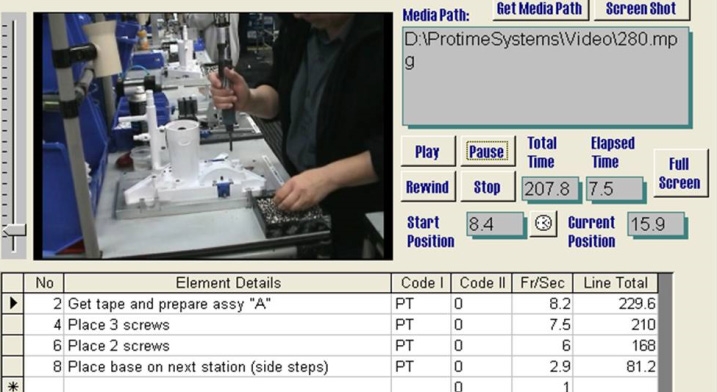
Many, or all, of the products have problems. First, make sure production stops until a solution is found. They should not keep making the same defects. They should find a way to correct their process before resuming work.
Second, give them clear criteria to guide their 100% sorting job. They will have to go through the goods they have already made, to decide whether they are acceptable.
All of the goods that are NOT acceptable must be clearly identified and ideally quarantined away from the production line.
3. Checking earlier is better
By now you certainly understand why checking earlier is better. Catching problems early gives you the time to study the problems, tell the factory what is not acceptable, look for countermeasures and test them, and adjust your schedule.
As you can guess, for large orders it often makes sense for the customer to send inspectors at several times during the production cycle. In certain cases, an inspector is stationed for several weeks in the factory.
If you wait until the whole production is completed and you find quality issues at that point, it might be too late. Sometimes re-working the defective goods takes weeks. And they might all need to be re-produced, which is very time-consuming and expensive… and is rarely done at the factory’s cost.
The sad truth is that, even though most production problems are the manufacturer’s fault, they rarely take responsibility. This is why enforceable contracts (see Chapter 6 about leverage) can save your a**!
The General rule is the earlier you find an issue the less expensive it is to rectify:
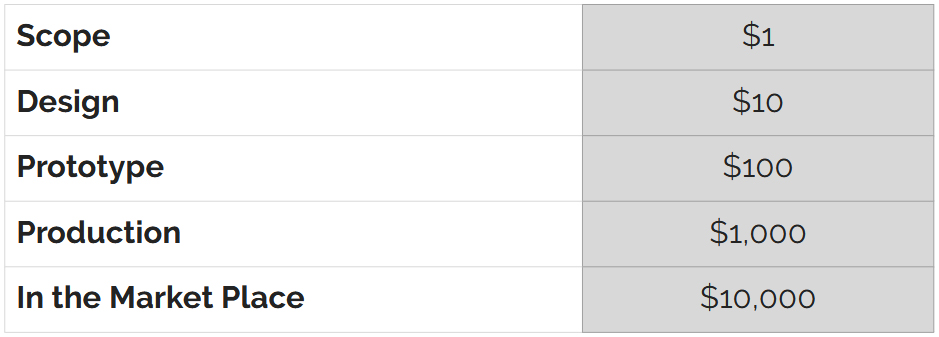
It’s also known as the 1:10:100 ratio:
- Fixing problems in development is about 10 times faster and cheaper than in production.
- Fixing problems in production is also about 10 times faster and cheaper than after the products have been sold.
- Consequently: fixing problems in development is about 100 times faster and cheaper than after the products have been sold.
4. A few more benefits of early production inspections
An inspection during production is also an easy way to draw a few samples from production and to send them to a testing laboratory. If you only do this during a final inspection, you might have to wait for the lab’s result for a week before giving the green light to the supplier to ship.
The inspector will use the specifications you have written as a checklist, and if possible an approved sample for reference. That’s where the hard work you did after lesson 7 starts to bear its fruits.

Chapter 10
Always Verify Quality Before Shipment
Once the products hit your dock and once you have paid 100% of the order, there is little you can do in case products are not up to your specifications.
Chances are, you have already paid the supplier in full. And the supplier will certainly not give your money back, or re-produce for free (it does happen, but very seldom).
That’s why professional importers generally have every order inspected before shipment. (Chinese factories are famous for cheapening the product when the buyer starts feeling more confident.)
1. When does a final inspection take place?
It takes place once 100% of the shipment quantity is finished and when at least 80% is packed. This way, the cartons can be counted and the quantity can be estimated.

The big advantage is that samples can be taken at random — the manufacturer cannot hide half the products in a back room and pretend all the goods are in front of the inspector.
Make sure you have a few days between the final inspection and the deadline for giving the green light for shipment:

The manufacturer might have to do minor corrections on the packing or the labelling, for example, and you might need them to send you a few photos and explanations, before you make a decision.
2. Where should a final inspection take place?
It is usually conducted in the factory. This way, if re-work is needed, the manufacturer can do it right away.
It is important for a representative of the supplier to understand what (if anything) went wrong. Typically, the inspector(s) asks the supplier to sign on the list of problems found.
Conflicts sometimes arise. But, in most of these cases, the buyer hasn’t taken the time to define clear specifications (see Chapter 7). If the quality standard is clear, there should be no surprise and no argument!
3. What is checked in a final inspection, and can’t be checked earlier?
In the previous chapter, I listed the benefits of an inspection during production, but a final inspection is usually necessary as a complement, for the following reasons:
- As I wrote above, the presented quantity can be estimated, which means we can pick samples that are representative of the whole batch.
- The inner packaging, the export packing, and the labelling are usually added to the products a few days before shipment. They are essential to protect the products, and to ensure smooth handling along the supply chain.
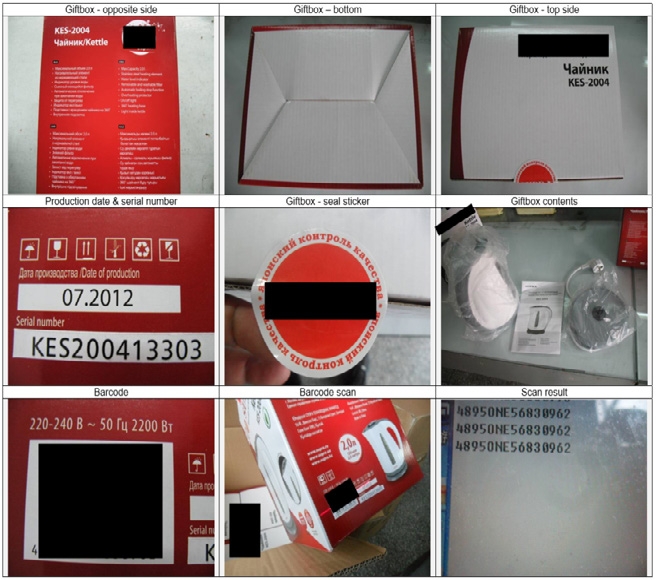
Typically, your spec sheet will become the inspector’s checklist. Every aspect of the product and its packaging can be checked/tested, if the factory allows it and provides the necessary equipment.
As a consequence, most quality control jobs are performed a few days before shipment, rather than during production. For example, if I look at our clients’ bookings, over 70% of all inspections are final inspections.
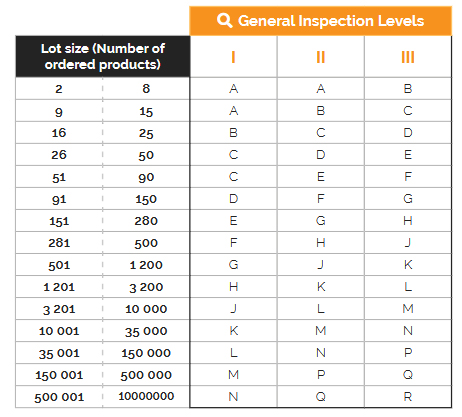 4. The statistics used in the quality control industry
Whether you appoint a professional quality assurance agency, or you handle this internally, it is good to know what statistical rules are used in the industry. You should know more about it than your suppliers, or their interpretations might confuse you.
- You can view a screencast about how to read the AQL tables here.
- You can get the most commonly-used AQL tables here.
5. What to do when a big problem is noticed at that stage?
First, as I advised in chapter 6, you should definitely make sure quality is acceptable before you pay the remainder of what you owe your supplier. Do NOT play it nice. Keep a part of the payment until they have done the corrections you required.

Then, there are several cases:
If you estimate the manufacturer can simply sort the bad pieces out, or re-work some bad pieces, then you should follow the procedure I outlined here.
If you need the supplier to analyze what the origin of the problem is and to report it to you, you can ask them to prepare a CAPA form (see an example here).
If the manufacturer doesn’t take action on the root of the problem, or if you feel that they are going in the wrong direction, you need to take action. You need to send an engineer who is familiar with the factory’s process to discuss with their technicians.
That engineer should look for the root cause, propose countermeasures (while taking into account the manufacturer’s suggestions), and try to run a test while he is in the factory.
If ever you need that type of help, contact me and I will try to send you in the right direction.

Chapter 11
Build Good Rapport with Suppliers
Up until now, I have written about “hard” issues: screening suppliers, writing specifications, negotiating the right terms, and inspecting quality.
But I feel I should take a moment and focus on “soft” issues, and in particular, how to build good rapport with suppliers because it is so important, while at the same time so difficult to get right.
First, let’s look at what specialists call the “inner circle” and the “outer circle”.
1. Some background: the inner and outer circles
I might be guilty of grossly over-generalizing here, but I feel that the Chinese are still very close to the village community system, where anyone from a different town cannot be trusted.
They care a lot about their family, their close friends, and some of their colleagues or customers; however, they don’t care about what happens to people who are outside their circle. When I say “they don’t care” it is more like they do not want to get involved with anyone outside their circle regardless of the trouble or danger those outsiders could be in, they would rather turn the other way and walk past instead of helping.

What does it mean for the foreign buyer?
Should you try to make friends with suppliers’ salespeople and managers?
It can help but this is a fine line.
It means you should spend quality time with them outside of work – for example joining them for a group meal.
You should talk about you and your family, and inquire about theirs. Show photos of your city, bring specialties from your country, teach them a few funny words, and so on. It will all help you get closer to their inner circle, and your orders will get a higher priority in their minds because of the relationship that is being built.
It does NOT mean that friendship comes before business, though. Here are two examples:
- If they produce inferior quality or they ship goods late, they should expect that you would
act tough. - If they suggest inspecting quality by themselves (basically asking you to trust them blindly),
you should brush that idea off immediately.
2. Visit the factory frequently
In China, face-to-face meetings are much more productive than emails or phone calls, especially if you can get in front of decision-makers.
You are probably in contact with a salesperson, who has a limited influence in the organization. If you can, come regularly to China and talk to the middle managers (who allocate capacity and set priorities) and/or the technicians working on your orders.
If you have already met with the boss during a previous visit, remember his name and ask for his input. He might not physically be able to attend your meeting, but you can ask the sales rep to ask for his decision when you get stuck on an important issue.
3. Be seen as a “good customer”
More and more Chinese suppliers have realized that they need to cultivate a certain number of good buyers and treat them well. From a buyer’s point of view, it does not take much to achieve this status.
Show that you care about your supplier. Ask questions to understand their situation, and try to take it into account in your decisions (at least in a small way). This will help you be categorized as a “good customer”, even if you insist on following professional processes.
4. Remain polite
Some buyers are disrespectful towards their Chinese suppliers, particularly when problems arise, and this attitude is usually counterproductive.
Again, this is a fine line. When you drive a car you can be assertive, but you should not be aggressive. Same thing when you address your suppliers!

You should avoid asking tough questions in a direct manner. I remember one of my clients who, after being shown a factory’s mistakes, placed some samples on a table and asked “why did this happen?”, “didn’t you control the materials, as you promised us before?”, “why didn’t the line operators catch it?”, and so on.
Big mistake, my client offended all the key people working on his project on a personal level by putting down mid-level people in the supplier’s company. And in public. They lost face!
What is face, you might ask?
In situations where someone has made a mistake or done wrong, and the error is made attributable to that person in public, then that one person has “lost face” – their reputation in the eyes of their peers has been reduced. Losing face is an experience no-one wishes to have befall them. So, even if the one losing face is clearly “wrong”, some folks will go to great lengths to avoid the appearance of losing face.
If the factory is clearly at fault, you should work with them to identify the root cause(s) of the faults and set corrective actions then follow up to check their progress.
Business is business, and you should defend your interests, however, keep in mind that Chinese people tend to mix professional and personal relationships.
Now, if you are in front of the factory owner and if you are one of their significant customers, you can push hard. You can be tough and scream in private, not in front of staff. As Paul Midler wrote in his latest book, nothing can offend them.
5. Use email wisely
So, you, or your inspector, have found a problem. What should you do?
If you are at the factory yourself, everything is easier. You can give them immediate feedback about what is acceptable and what is not (you should take photos and write a note about it).
If you are not on site, you should send emails to convey information (photos, lists of problems, potential root cause, etc.) and ask for a response. Try to make only one point per message. Then you can call your contact to ensure they have received your email and they understand what you are explaining and then ask when they will respond.
Do not send and re-send long emails. If you apply too much pressure, you will probably not get a clear response. Similarly, be careful not to place blame on any particular person.
The natural tendency of Chinese suppliers will be to justify themselves and find an excuse (which will often be a “white lie”). The most important thing is to get them to formulate their next corrective actions and to commit to a time frame. Keep focused on this, rather than asking “who messed up?”


Chapter 12
How Closely Do You Follow Your Productions?
Up until now, I have written advice that is targeted at certain types of importers. I call them the “hands-on buyers”, and I know them well because many of them are our clients. They tend to follow productions closely.
However, let’s not overlook a good half of the buyers — the “hands-off buyers”.
My point here is really this: there is no one set of “best practices”. As far as importers are concerned, there are at least two types of buying strategies that can make sense.
First, let’s examine what hands-off buyers do, and why it makes sense in their situation.
1. The hands-off buyer
Let’s take an example. You purchase promotional goods that are then given away.
One day a customer will ask for a bottle opener. The next, you will need to look for caps. Then paper bags, and then pens, and so on.
All these products are made in different factories. As your business grows, you end up with tens of suppliers and tens of products!
It means you can’t get familiar with all your suppliers. You can’t become an expert in every product category.
(By the way, promo item buyers are not the only ones in this situation. Think of mail-order companies or retail chains that deal with thousands of SKUs!)

2. Why it can make sense to be ‘hands-off’
Buyers who place one-shot orders are forced to take high risks. They can only focus on a few risk mitigation strategies.
If we revisit the advice I gave you since the first chapter, here is the typical hands-off buyer’s sourcing strategy:
- Supplier identification and screening: Buyer becomes expert at completing this stage efficiently.
- Factory verification: Very light. Buyer is not building a long-term supply base.
- Cultivating backup suppliers: Only possible with off-the-shelf items.
- Negotiating the right terms: Very important for the purchaser to get this right.
- Keeping leverage in your hands: Buyer becomes expert at managing financial risks.
- Writing detailed specifications: Not realistic. Buyer has insufficient product expertise and little time.
- Following up on production schedules: Always a challenge, especially with small suppliers.
- Checking product quality early: Only realistic if the amount is very high or if the customer cannot be disappointed.
- Checking every shipment in the factory: A must. Manufacturer is not trusted at all.
- Building good rapport with suppliers: Not realistic. Relationships are often adversarial.
To read more about this strategy, you can go to Hands-off buyers: accepting the risks of importing.
3. When does it make sense to be hands-on?
If you can work with a few manufacturers, it makes sense to spend more time and effort developing the relationship. You can spend more time in the due diligence phase, to ensure you work with good partners.
It reduces your risks in two ways:
- You work with better-qualified suppliers who understand the relationship might span five or ten years.
- You probably deal with one or two product categories, so you know your product and its production processes better. It allows you to distinguish good manufacturers more easily, and to understand what might go wrong in the manufacturing stage.

4. What do hands-on buyers do that is special?
Being hands-on is the only option for buyers who need bespoke or heavily customized products. It forces you to work closer with the supplier, and to commit to longer-term business.
There is a risk to watch out for. You might get “locked” in a relationship with one manufacturer, who knows it will take you 6 months to ramp up another source and get good products. They might become less serious about quality or deadlines, or they might increase prices too fast.
This is why a backup manufacturer is so important. It allows you to keep pressure on your current supply base, and it gives you a good option out if required.
Another special characteristic of hands-on buyers is that they push their suppliers to improve. And, in most cases, they are frustrated by the resistance to their suggestions.
For many importing companies, pushing key suppliers to improve has become more critical over the past 5 years. And this trend will only get stronger. After all, if they don’t become more efficient or if they don’t improve their quality, most Chinese factories will have to close!
That’s why I will cover this topic in the next 3 chapters.

Chapter 13
The 5 Steps to Developing a Chinese Supplier
Many importers work in one or two product categories. They buy 80% of their volume from 1-4 manufacturers.
And many of them make the same mistake: they don’t try to improve their CURRENT suppliers. Instead, they spend time sourcing NEW factories and training them to their requirements, and consequently they are taking risks on the first order from a new supplier. Is there an alternative? Sure.
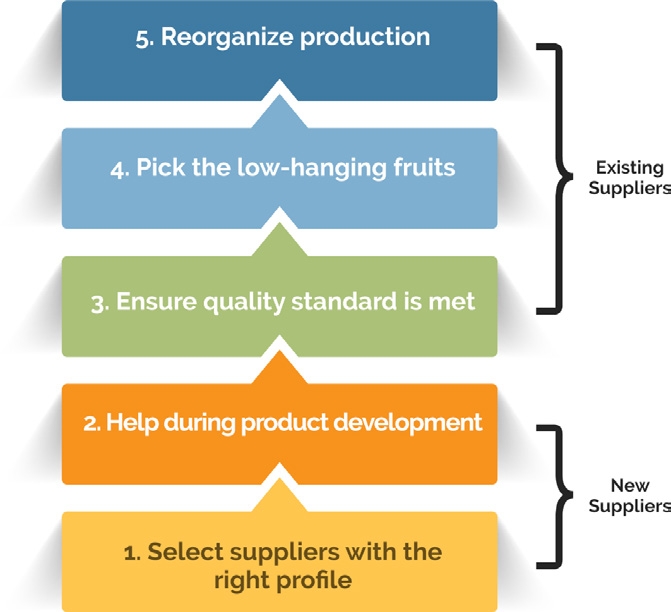
A supplier development program follows 5 steps. And it starts at the sourcing phase!
1. Selecting suppliers with the right profile
This is all about finding suppliers that want to improve, however, if you work with companies that are NOT trying to improve, the upside will be quite limited.
A large customer can push a factory to make improvements, but it’s quite hard (sometimes impossible) if that factory’s boss doesn’t care about getting better. Many of these bosses are only interested in getting bigger, by using their current operations and practices.
How to spot potential suppliers that are motivated to get better? Here are a few examples.
- hey re-invest profits in the facilities, the equipment, staff training, and so on;
- They want to develop new products/technologies, and are willing to go through a steep learning curve;
- They hire professional managers rather than members of the owner’s extended family.
2. Help during product development
This step is important if you purchase highly customized products.
The buyer needs to take the following actions:
- Explain the product’s specifications clearly;
- Translate what these specs mean, from a technical point of view (at the production process level);
- Train their QC staff to check the specs during production and on finished products (this critical step is often forgotten);
- Give detailed feedback on pre-production samples/prototypes.
For complex products, spending time in the factory and communicating directly (in Chinese)
with the technicians is a big plus.

3. Ensure your quality standard is met
As your first orders move into production, the focus should be on quality. If production quality is not acceptable in your market, and if there is no improvement over time, there is no way to continue the relationship.
The question is; how do you get a supplier to improve its quality, without spending a fortune on inspection in order to catch all their mistakes?
You need to audit their quality system and their processes, and then evaluate what the priorities are. Here are a few examples:
- The managers never get out of their offices, and don’t monitor discipline on the shop floor.
- Incoming components & materials are not checked, or nobody knows when they should be rejected.
- There are no procedures or procedures are insufficient/unclear for in-process inspections.
- Work instructions for workers are not accurate, poorly designed, or not respected.
- Nobody has collected data about the most frequent defects and wondered what their root causes are in a systematic way.
The best policy for those buyers who purchase large quantities from one supplier, is to send an engineer to the factory on a regular basis (once a month), to discuss and show the supplier potential opportunities for improvement and identify where processes could be made clearer or better (don’t call it “audits”), I detailed how it works in this article.
Once a manufacturer has a strong system in place and inspires enough confidence, they can be allowed to “self-inspect” and to report their findings to the buyer.

4. Pick the low-hanging fruits
To an experienced industrial engineer, the typical Chinese factory is full of opportunities for improvement. A lot of small changes can be made to cut costs, without investing in any new equipment or breaking any walls.
By applying a gentle mix of pulling and pushing, you can probably help some of your key suppliers grasp some of these obvious opportunities.
For example, some importers ask key suppliers for a roadmap to reduce their cost structure in the coming years (with details on how they intend to achieve these targets). This is an excellent exercise to push suppliers to think of how to work smarter, and to run some tests.
Some other buyers know production processes better than most manufacturers they work with, and help them reduce their “costs of poor quality” (scrapped material, defects to rework, chargebacks from customers…).
Good communication and frequent visits are key if you want this effort to be successful.
5. Re-organize production
Step No.4 focused on the “easy wins” that require little effort and bring obvious gains.
Once you have accumulated enough of these easy wins and the factory’s management starts to trust you, it is time to become more ambitious.

Here is the sequence I advise you to follow:
- Select one priority — here are 4 examples: quality, cost, faster production cycle and
smaller batches; - Select 2-4 KPIs, and track their improvement over time;
- Pick targets for the KPIs, and envision the “future state” that needs to be achieved to meet these targets;
- Discuss it with the factory and get their agreement and buy in;
- Make changes to reach that future state, if possible by starting with a “quick win” that everybody can see;
- Start over again with a new target, after the team has achieved a sense of victory and has the energy to take on another challenge.
In the next two chapters (14 & 15), I will explain how “Lean”, a set of principles and techniques inspired by the Toyota Production System, can help you drive impressive results in quality improvement and in cost reduction.
Chapter 14
How a Factory Can Improve Quality
I bet you are tired of hearing your Chinese suppliers say “this is made by hand, so avoiding defects is impossible”.
So am I, because it’s 100% wrong.
Some small factories have decreased their defect rate below 50 parts per million (that’s 0.005%). One of them, in Japan, employs housewives in the countryside, and their operations are all manual!
So, how do they get so close to zero defects? The answer is by applying a set of principles.
1. Faster production cycles help improve quality
Many factories that have implemented lean have managed to reduce their cycle time (the time between starting a production run and getting some finished products) by 80% – 90%.
To simplify what happens, they go from this….

To this…

This is the best way to avoid widespread quality problems.
Why? Because finished products can be inspected/tested a few hours (maximum) after a production is launched, and the root cause(s) of a defect is much easier to find – the production batch is probably still in work-in-process status and “the trail is still hot”, as they say.
In contrast to that, I have seen many Chinese factories discover a widespread problem with a production batch after thousands of pieces have already passed through the faulty process. The trouble here is that because the production batch has already been completed it is much more difficult to identify where the root cause of the problem took place — let alone fix the issue right away before it affects the whole batch.

2. Strong discipline improves adherence to standards
Putting a system in place is not the hard part, especially when ISO 9001-compliant quality systems are available on the internet and are (supposedly) ready to be used.
It doesn’t take months of work to place work instructions as well as photos of good and bad samples at each work station.
The hard part is training, coaching, and enforcement. There is no substitute for managers walking the shop floor every day and checking what the production staffs are doing.
What Chinese Managers tend to do however, is stay in their air-conditioned offices or meeting rooms. This lack of presence on the factory floor is quite unfortunate from both the factory’s and the buyer’s point of view.

When I first walk in a factory and I want to assess their quality level, I often carry out this simple 3-point test:
- Does the place seem to be in order? Do the operators wear appropriate clothes and protective equipment?
- Are there process controls and product checks, and is there a way to see if they have been done? (This could be written QC records or anything else that allows a supervisor to ensure it was checked.)
- If I ask them to describe the changes that have been made to one of their control documents (procedures, work instructions, forms…) over the last 3 months, do they need to “go and check” first?
If the answers to points 1 and 2 are YES and point 3 can be answered straight away, it tells me that there is some sort of structure and process that is being followed, which is a very positive sign.
3. The necessity for self-inspection
By self-inspection I mean the operators themselves do most of the quality control work. Not dedicated inspectors.
I don’t mean each worker should evaluate their own work – they lack the objectivity necessary for that.
The key is in successive inspection: I grab the part, I check it, I process it, and I put it down.
Here are the 3 basic principles that every worker MUST adhere to:
- We do not accept bad work
- We do not do bad work
- We do not pass on bad work
Does it conflict with the pay scheme so commonly applied in China (paying the operator based solely on the number of pieces he/she makes)? Yes, sure, but compensation structures can be changed.
Does it take more time for the operators to do these checks? Yes it can. And that’s a problem when a tough deadline needs to be met: operators might “exceptionally” choose to suspend self-inspection.
Fortunately, this extra time can be greatly reduced–and sometimes eliminated entirely–if you get creative, as we’ll see in next part.
4. The magic of mistake proofing and usability engineering
On your computer, have you ever inserted a cable (for example the power cord) in a wrong hole? It is impossible because they all have different shapes and sizes.
Some PC manufacturers have even color-coded the cables and the corresponding holes. Strictly speaking, that’s not mistake proofing because it does not always prevent mistakes. That’s usability engineering. But it still brings tremendous value.
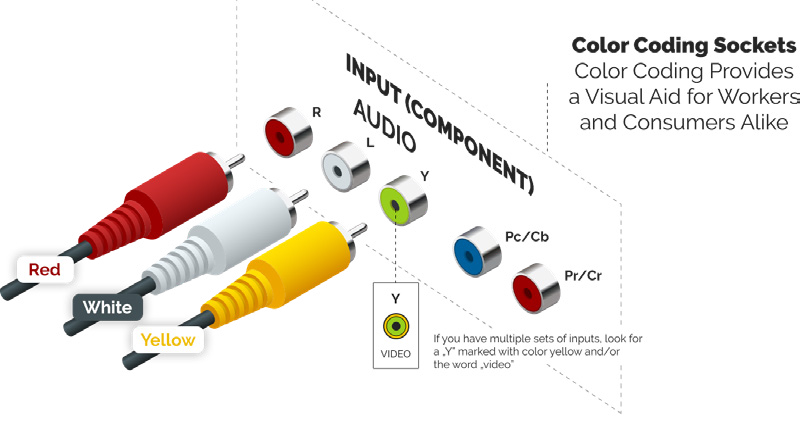
Does it cost a lot of money? No. Is it effective? Yes!
Now, have you seen this type of thinking applied by a Chinese manufacturer?
- Would they think of asking the designer to make the holes different shapes/sizes? Probably not.
- Would they think of color-coding each hole and each cable? The probability is even lower.
Some manufacturers in Japan and in the West have become masters at mistake-proofing. You can find 240 pages of real examples that were implemented in factory settings here.
Here is a simple example (guide pins of different sizes, in a set of fixtures):
Could more than 4 principles be listed? Sure. I didn’t mention staff training and barely mentioned process control.
The 4 pieces of advice I listed above are those that generally make a big difference in a manufacturer’s quality level in a short amount of time. And the beauty is… It does not require any capital investment. Forget about automation, keep the same people, and show them how to work smarter!


Chapter 15
How a Factory Can Improve Productivity
In the previous chapter, I introduced lean manufacturing as a set of principles and tools that both increase productivity and improve quality.
Here we will focus on productivity. Why is it important for buyers? Because, unless your suppliers make progress in this area in the next 5-10 years, many of them will go out of business.
Admittedly, if you are not their biggest customer, they will not follow your suggestions of re-organizing production, but it is your responsibility to open their minds about best-in-class practices.
I have prepared a simple explanation of how productivity can be increased in a factory, based on a few examples.
(In the spirit of lean, I will go heavy on visual communication in this article. Lots of graphs and photos.)
1. Improve the general flow of materials
In this example, I worked on improving the flow in a powder coating workshop.
As you can see in the sketch below, the parts were traveling a lot (The flow started at the bottom left and ended at the top left).
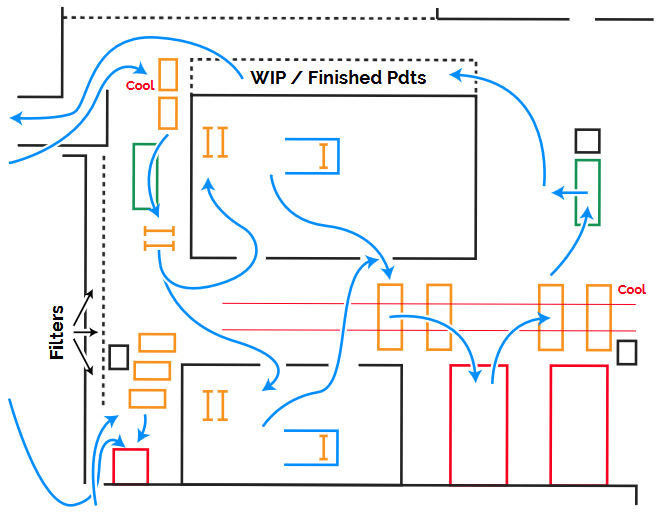
I suggested the factory should make some space so they could store the parts very close to the next process step, as shown in the sketch at the bottom of the page.
Breaking down walls was not necessary, but it was important to modify the tables, add some storage locations, and organize the flow differently.
I cut little pieces of paper in order to simulate the new workflow and to communicate the way it would work:


Since the workshop supervisor had bought into the idea, they moved ahead and implemented my suggestions. This resulted in eight less operators to complete the tasks in this section (they were moved to alternative job functions within the factory where they could be more effective).
The change meant they stopped pushing large carts hundreds of meters, but it also reduced how frequently the parts were handled by half (as a result of using smaller tables). This brings us nicely onto factory layout issues…
2. Improve the layout within each process
In this next example, I studied a drilling process. Here again, they were spending a lot of time handling the pieces.
Three people were working on the process.
Note: WIP stands for “work-in-process inventory”
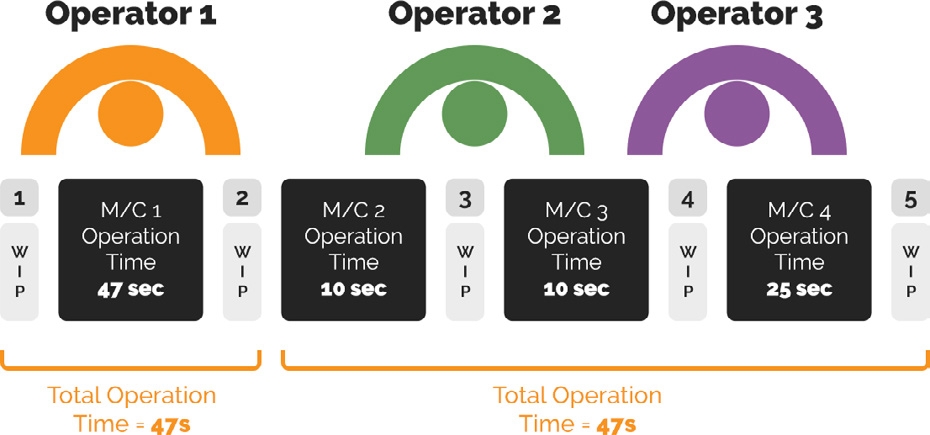
If we look at the process times, operator 1 was taking 47 seconds to complete his task whereas the total process time to complete operations 2, 3, and 4 was 45 seconds; however, it took two operators to complete these tasks.
Why was it taking two operators to complete tasks with a process time LESS than the process time of the first operator? It was simply because they were stacking the parts up carefully between each machine (as can be seen in the photo below). Picking up parts and stacking them again takes a LOT of time and effort as well as adding time to the overall process.
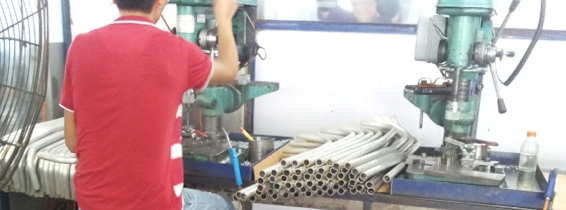
Easy conclusion: by taking one part and moving it through the last 3 machines, one operator is enough to complete tasks 2, 3, and 4, which results in a balanced line with one-piece workflow:

Is this type of change alone enough? No of course not, there would be many other details that would need to be addressed.
For example, most Chinese manufacturers like to use large boxes such as this one:
The logistics guys love these large boxes, however, they do make up for time-consuming and tiring (if not downright unsafe) manual handling work for operators.
A better practice is to have the logistics department “prepare” the components in smaller containers that are made available right at the point of use. Better yet, use item-specific dunnage to make counting and picking easier.
3. Update the work standards
As you walk around some Chinese factories, you have probably seen this type of instruction posted on each workstation.
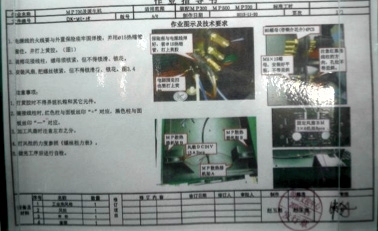
From my experience, most of these instructions are out-of-date but external auditors are too lazy to notice that detail or to read them carefully and to check whether the operators are following them.
Whenever an element of the layout changes, it impacts the way operators should perform their job. In turn, these changes should make their way onto the work instruction sheets.
Then comes the hard part; strong discipline is necessary to ensure changes are followed, and supervisors should provide coaching and training where and when needed.
4. Other factors
I chose to focus on simple ways of improving productivity. It is important to score a few easy wins, before a Chinese factory owner starts to trust any external party.
Are there other factors that can increase productivity? Yes, there are many. Here are three examples:
- Well thought-out automation can help. Make sure to follow the right timeline
- New tools/jigs/fixtures can save a lot of time, and at the same time prevent quality issues.
- Good DFM (Design For Manufacturing), rather than DFCL (“Design For Cheap Labor”), helps immensely.
To get back to the introduction of this article, I believe Chinese manufacturers that don’t up their game will be out of business in a few years.
Make sure you work with the survivors!