



This e-book will show you that a buyer’s decisions impact quality from the very beginning of a sourcing project.
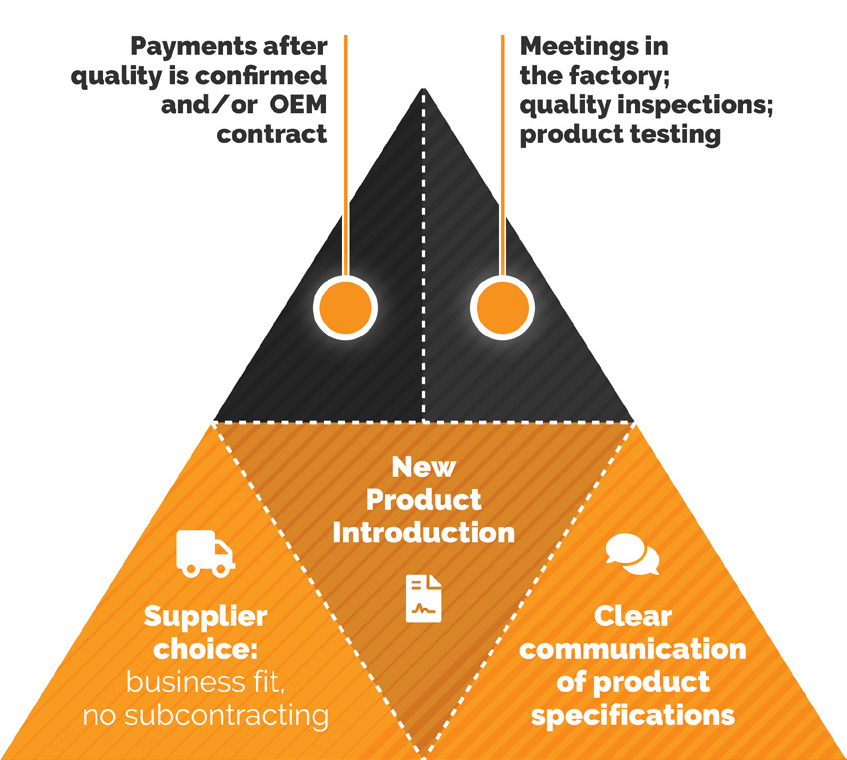
These are the 5 foundations of a robust quality assurance strategy for importers who are outsourcing production to Chinese or Vietnamese suppliers.
Introduction
Setting Realistic Objectives
Outsourcing production to China or Vietnam requires more planning and more work than buying from a wholesaler in your country. Getting a price and a sample is only the beginning.
Here are a few considerations to keep in mind:

REGARDING COSTING
Importers often forget to budget for supplier qualification efforts (background checks, factory visits…) and product quality inspections. By doing this, they save pennies but put dollars at risk.
REGARDING TIMING:
Your supplier will promise you a shipment date. But there will often be delays–because you take too long to approve their samples and/or because they are late in production. Keep at least 2 weeks of safety in your planning. Remember, rushing production will usually affect product quality.
REGARDING QUALITY:
It is YOUR responsibility to communicate clear specifications to the supplier, and then to verify whether they are met.
Warning: most manufacturers in low-cost Asian countries do not understand that if you get substandard quality, you will not be able to sell your goods at all. They often have a tendency to settle for what is “probably good enough”.
Foundation 1
Finding Suitable Suppliers
If you purchase customized (made-to-order) products, you need to look for the right source. Switching suppliers down the road can be difficult—getting the development and the production right can take more than 6 months for a new factory.
So, what criteria should you consider?
Do not look for the biggest factory, the lowest price, or an ISO 9001 certificate.
The key questions to answer are: “is my business attractive to this supplier, and is he capable of delivering as needed?”
The most important aspect is their size. Ideally you should represent 10% to 50% of their volume:
- Do not choose a huge manufacturer who won’t be flexible and will never give you priority
- Conversely, avoid small workshops (less than 80 workers) that are highly unreliable.
You should have a good look at the factory (by sending your staff or an independent auditor):
- Is it large enough for your orders during the peak season?
- Do they regularly make products very similar to yours?
- Is their quality system relatively mature?
- Can they give you references of other customers that you can call?
Beware of uncontrolled subcontracting.
Subcontracting to a cheap workshop is very common, and it is detrimental to quality in 95% of cases
To prevent it, there are two things you can do:
- Ask your supplier to certify in writing that production will take place in the factory they presented;
- Conduct an inspection when production in under way (see foundation 4).
Foundation 1
Finding Suitable Suppliers
The 3 levels of suppliers
Before you start looking for a supplier, ask yourself: ‘what type of supplier would be best for us, knowing our situation (order size, need for flexibility, quality standard…)?

Sofeast offer you a consolidated initial supplier vetting program including business registration check & initial factory evaluation tailor-made for importers who need help to start outsourcing to Asian suppliers. You can choose from these solutions to help get you started as well:
You can choose from these solutions to help get you started as well:
Foundation 2
Defining Your Requirements Before Production Starts
Some importers see a sample, approve it, and ask the supplier to launch production. This might be appropriate for some very standardized items such as computer wires, but for most products it is very dangerous.
A SAMPLE IS NOT ENOUGH
You should approve a “perfect sample”, but you should also write every detail about the materials, the product specifications, and the packaging.
For every piece of information that you don’t provide, a purchaser or a technician from the factory will have to make a choice. Are you sure that person will understand the intended use of your products, and all the little things that seem obvious to you? Will she resist the temptation to go for the easiest and cheapest solution?
DO NOT FORGET SAFETY STANDARDS
You should also get information about the safety regulations that are applicable to your product in the countries where it will be distributed.
You may visit official websites, or ask a quality assurance firm, a testing laboratory, or a lawyer.
WRITE IT ALL DOWN
The best practice is to list your requirements in very precise terms, leaving no room for interpretation, and then having it translated into local language.
This way, your meaning will not be distorted by the English-speaking (non-technical) salesperson.
Then you should get a manager to approve your list of specifications and your perfect sample.
A signature at the bottom of a document can make for a powerful reminder, should you need it.
REQUIREMENTS ARE NOT ALWAYS RESPECTED
Most suppliers focus on getting new business, and it means their samples must be perfect.
However, bulk production rarely turns out as nice as the samples. If you, as the importer, have already wired a deposit and have promised the goods to your own customers, you cannot cancel the order easily.
Be prepared to discover that production is not up to your expectations. With a new factory, you should try to find out about it earlier rather than later (see block 4).
Foundation 2
Defining Your Requirements Before Production Starts
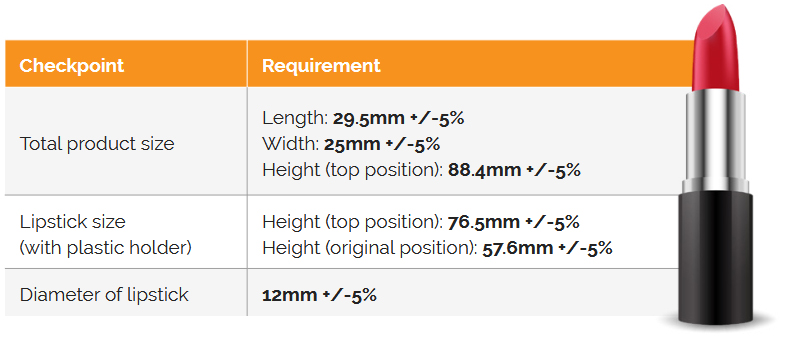
Example of simple checklist for a lipstick
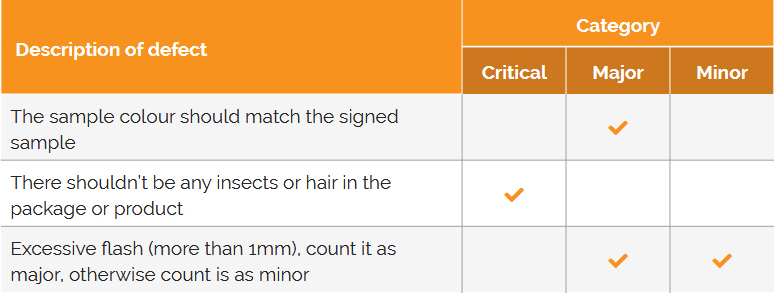
Example of simple defect list for a lipstick
Foundation 3
Don’t Skip the New Product Introduction Process
Note: this is only valid if you are going to develop & manufacture a totally new product. If you buy something ‘off the shelf’, go directly to block 4.
FROM DESIGN TO MANUFACTURING
The more unique your new product, the more work will be needed before production can start.
Your suppliers will probably reassure you – “don’t worry, this is all clear, and we’ll ship the goods 40 days after you confirm the prototype”. If that’s what you hear, your chances of being seriously late are above 80%.
THE THREE MOST COMMON MISTAKES
Most new product development projects in Asia are failures, and here are the most common reasons:
- Thinking that the factory is very familiar with the product space and will know what to do. The more unique your product, the higher the risks.
- Not checking quality of all key components before assembly starts.
- Missing very important elements such as operator training, testing stations, compliance testing, etc.
Foundation 3
Don’t Skip the New Product Introduction Process
GETTING PEOPLE TO WORK TOGETHER
Some companies work with a design house, then they throw a design ‘over a wall’ to some engineering staff, who then again ‘throw drawings over a wall’ to a factory’s purchasing and manufacturing departments.

All these people need to communicate. Feedback loops are very helpful. Otherwise, decisions made upstream will cause very serious issues (extra costs, higher complexity and longer time to market, etc.) down the road.
Foundation 3
Don’t Skip the New Product Introduction Process
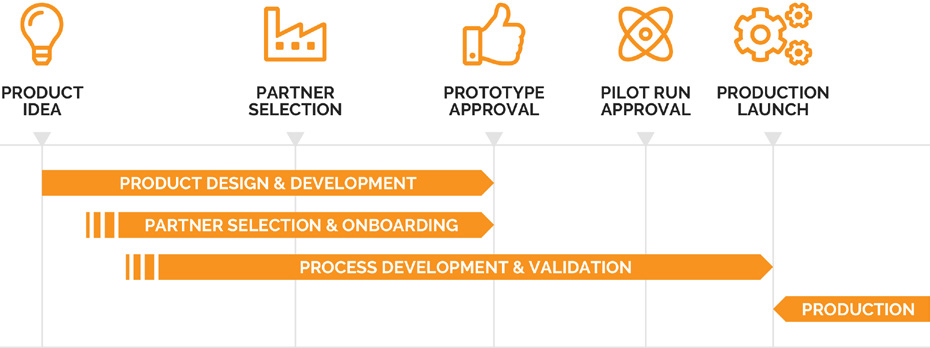
NEW PRODUCT INTRODUCTION IS A PROCESS, WITH SEVERAL OVERLAPPING PHASES
Design, engineering, and feedback from manufacturing, are done partly in parallel for best results.

If you’re getting ready to launch new products, get professional help from Sofeast’s manufacturing experts to keep you on track.
These solutions are for you in that case:
Foundation 4
Regular Quality Inspections (Trust but Verify)
Made-in-China products are seriously inadequate about 20% of the time. And sending a defective shipment back to China is nearly impossible. The situation in Vietnam is also no better if you are an SME.
Fortunately, your own staff or a third-party inspection company can check production quality—when the goods are still in the factory.
Warning: manufacturers usually don’t like to see professional inspectors (because they might have to re-work unacceptable products and/or pay for re-inspections). So the salesperson often says “trust me, I will check quality myself”. Do not fall into that trap.
INSPECTIONS DURING PRODUCTION
Checking the first finished products is very helpful to notice issues early. This way, the factory can immediately implement sorting & corrections, and you can plan accordingly.
FINAL RANDOM INSPECTIONS
For orders in regular factories, an inspection after production is finished (a few days before shipment) can keep some pressure on the factory and catch quality disasters. But if the products are not acceptable, it might be too late to re-work them.
HOW TO PLAN FOR INSPECTIONS:
- When you develop new products, ask for an extra sample (for the inspector’s reference).
- Write “quality inspection required, at any time deemed necessary by the buyer” on your POs.
- If you pay by letter of credit, ask for a passed inspection certificate from an inspection company that you nominate.
- Keep track of the final inspection date and the ex-factory date, not only the shipment date.
- Use your product specifications (see part 2) as checkpoints for the inspector.
Foundation 4
Regular Quality Inspections (Trust but Verify)
LABORATORY TESTS: A COMPLEMENT TO INSPECTIONS
Depending on the relevant safety standards, this is usually a must. You have a range of solutions.
- The cheapest and riskiest is to ask your supplier to provide certificates.
- The safest is to ask the inspector pick up samples at random, and to send them to a lab that you pay directly.
When to check quality during production? It depends on the risks you can foresee.
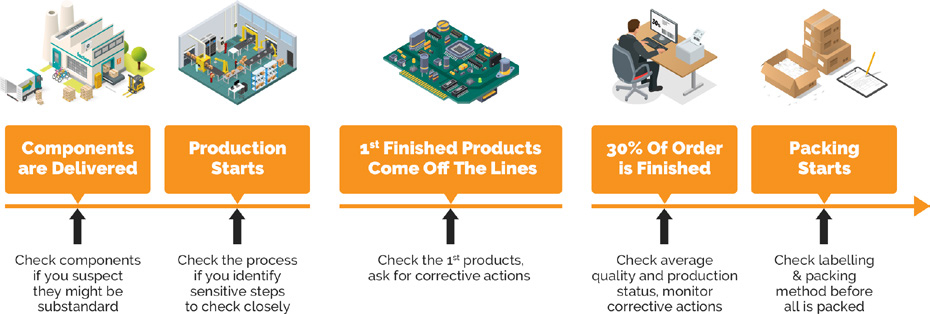
Sofeast provides a consolidated close production monitoring program for importers which includes consultation, inspector visits to the supplier factory, and follow-up.
You may also like these professional quality assurance solutions which are perfect for importers who need local quality assurance expertise:
Foundation 5
Tying Payments to Quality Approvals
Payment terms are very important because you are in a position of power as long as you owe money to your supplier:
- They will try not to be behind schedule because you might ask for a discount.
- They are not in a position to refuse quality inspections.
- They will have pressure to re-work the goods if your inspector finds quality issues.
Note: the opposite is true after you have wired a deposit: you are “hooked”—especially if your supplier can sell your production to other buyers.
Let’s consider the main tools at your disposal:
THE LETTER OF CREDIT (L/C)
The safest payment method is a letter of credit because you do not have to wire a deposit.
It is usually suitable for large orders and for untested suppliers. The list of specifications (foundation 2) and the passed inspection certificate (foundation 4) should be among the documents required by your bank.
THE BANK WIRE (T/T)
If you need to keep bank fees to a minimum, you can pay by bank transfer. It is the most common payment mode, but avoid these mistakes:
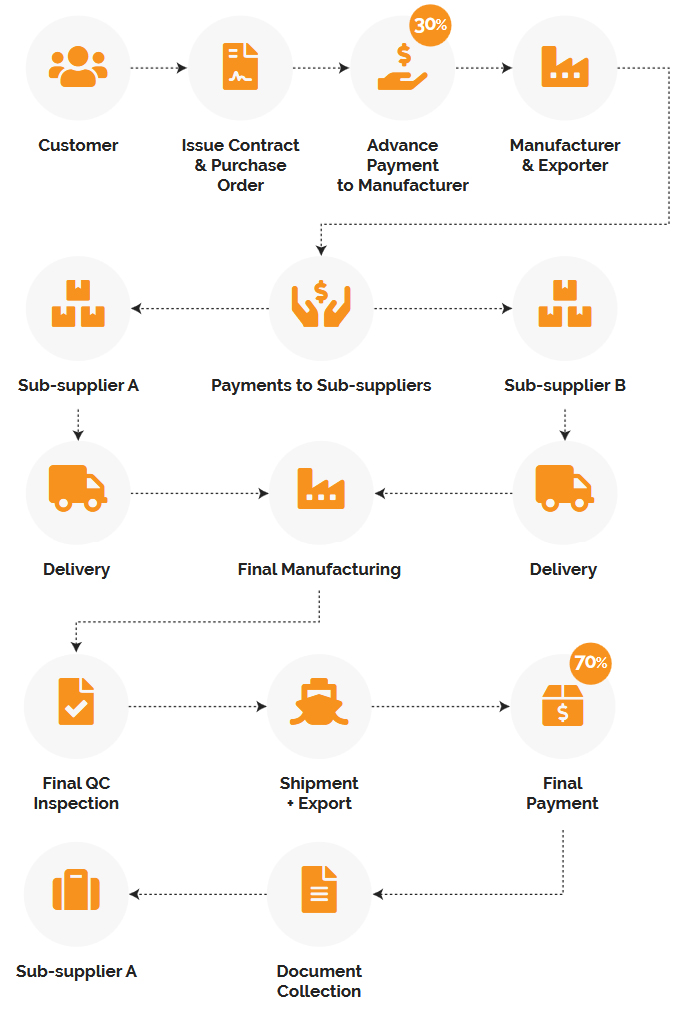
- Do not wire the 30% deposit before you get a perfect sample that you approve.
- Do not pay the remaining 70% before shipment.
If the supplier insists on a payment before shipment, negotiate a payment after you have inspected quality when production is 100% finished and packed.
There are slight variations of these numbers depending on the situation (maybe you need to wire something before a mold is opened).
But the general principle is: keep at least 40% of the order value on your account until production is finished and verified.
You should discuss these terms very early, at the same time as the pricing. If one supplier refuses, others will accept.
How Asian suppliers gets paid in most cases
Two Frequently Asked Questions
SHOULD WE BUY DIRECTLY FROM A MANUFACTURER?
Most intermediaries pretend to be manufacturers. (It is generally possible to verify it with an inexpensive background check).
But factories themselves routinely subcontract some orders, so this issue is not black-or-white.
Some importers feel more secure purchasing from professional brokers, but you should be careful:
- Trading companies work with cheaper (and less reliable) factories to maximize their margin.
- When there are quality issues, the buyer is kept in the dark. The trader’s interest is NOT to risk a cancelled order or to negotiate a discount.
- Traders don’t own the factory, so they don’t control it. Manufacturers usually give priority to their direct overseas customers, at the expense of the trading company and its customers.
SHOULD WE USE A CONTRACT IN CHINA?
China is said to have no law, but this is wrong. Enforcement of contracts is not a problem, as long as they are properly written by professionals. Do not use your regular lawyer for it, unless they have significant experience in China trade.
OEM agreements are a helpful tool, particularly for large orders and/or for situations that look particularly risky (e.g. you could not negotiate good payment terms).
The factory you approved, your product specifications and bill of materials, your payment terms, and your quality control plan will all be part of the OEM agreement. That’s why I touched on these points earlier. They are the cornerstones of successful China sourcing strategies.
Note: OEM contracts also address other considerations (e.g. protection of your firm’s intellectual property). Consult a specialized lawyer for accurate information.
Useful Blog Articles that Complement this eBook
- How to Send Good Design Files to Chinese Manufacturers. This article provides an overview.
- Product specifications template for importers in China can be found in this useful article.
- Quality control plan: defining expectations before production. You can get a greater understanding of this here and there is a useful infographic here.
- Different countries have different regulations that must be met in order to sell a product within that country. Here is a useful guide on the subject.
- Many small buyers don’t know where their products can be tested. To help out, here is a list of independent testing labs.
- How to prevent your suppliers from subcontracting, find out more here.
- Is it a waste of time to draft a contract and get it signed by your suppliers? No, it is not – especially if your order value is high. Find out why here.
- What should be in a purchase order (PO) to a Chinese supplier? Here is an article that includes a free download PO Template.
- Top 10 mistakes committed by importers: make sure you read this article.
- From risk management to product safety: risk and quality go hand in hand. When you reduce the risk, the product quality will rise. Read here .
- Read this article on what does quality mean to Chinese manufacturers?
- Want to know what the 5 building blocks for developing good Chinese suppliers are? Check out the blog post here.
- Tips to communicate effectively with Chinese suppliers – article can be read here.
- Here you can find useful tools for sourcing factories in China.
- Do importers NEED trading companies to buy in China? See what we say here.
- This article will detail how an importer can confirm his product’s quality while paying by bank wire (let’s say the deposit is 30%).
- How much should importers pay for pre-production samples? Find out here.
- If you source products from China, you MUST require pre-production samples before production is launched. Find out why here.
- Do you have challenges with pre-production samples? Check out this blog post.
- What to do with golden samples from Chinese suppliers? You can read more about this here.
- In this article we talk about confirming quality when paying by irrevocable letter of credit.